
The deed transfers. Keys change hands. And three weeks later your phone rings, and the person who bought your house is asking who’s paying for the furnace.
I’ve bought hundreds of houses, and the question of repairs after closing comes up constantly, usually from people who already moved out of state and assumed they were finished. Good news: the default answer tilts your way.
Is the Seller Responsible for Any Repairs After Closing?
Guess wrong here and you either pay for a roof you never owed, or you ignore a demand letter that turns into a lawsuit. Both outcomes are avoidable with about ten minutes of reading your own purchase agreement.
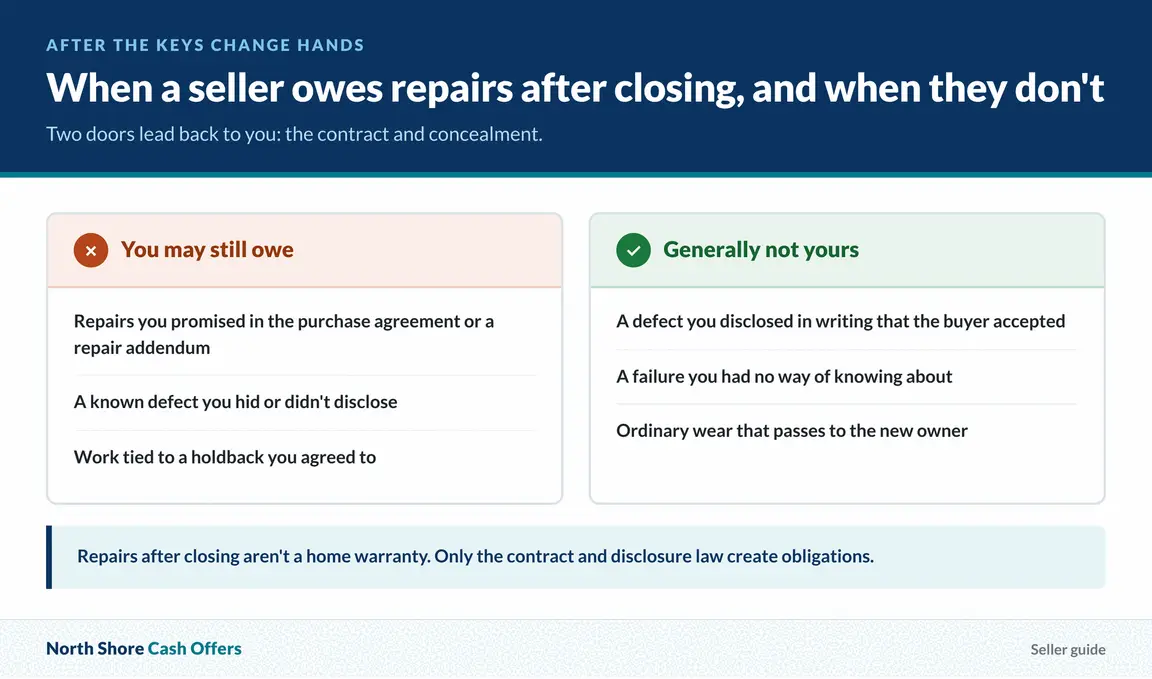
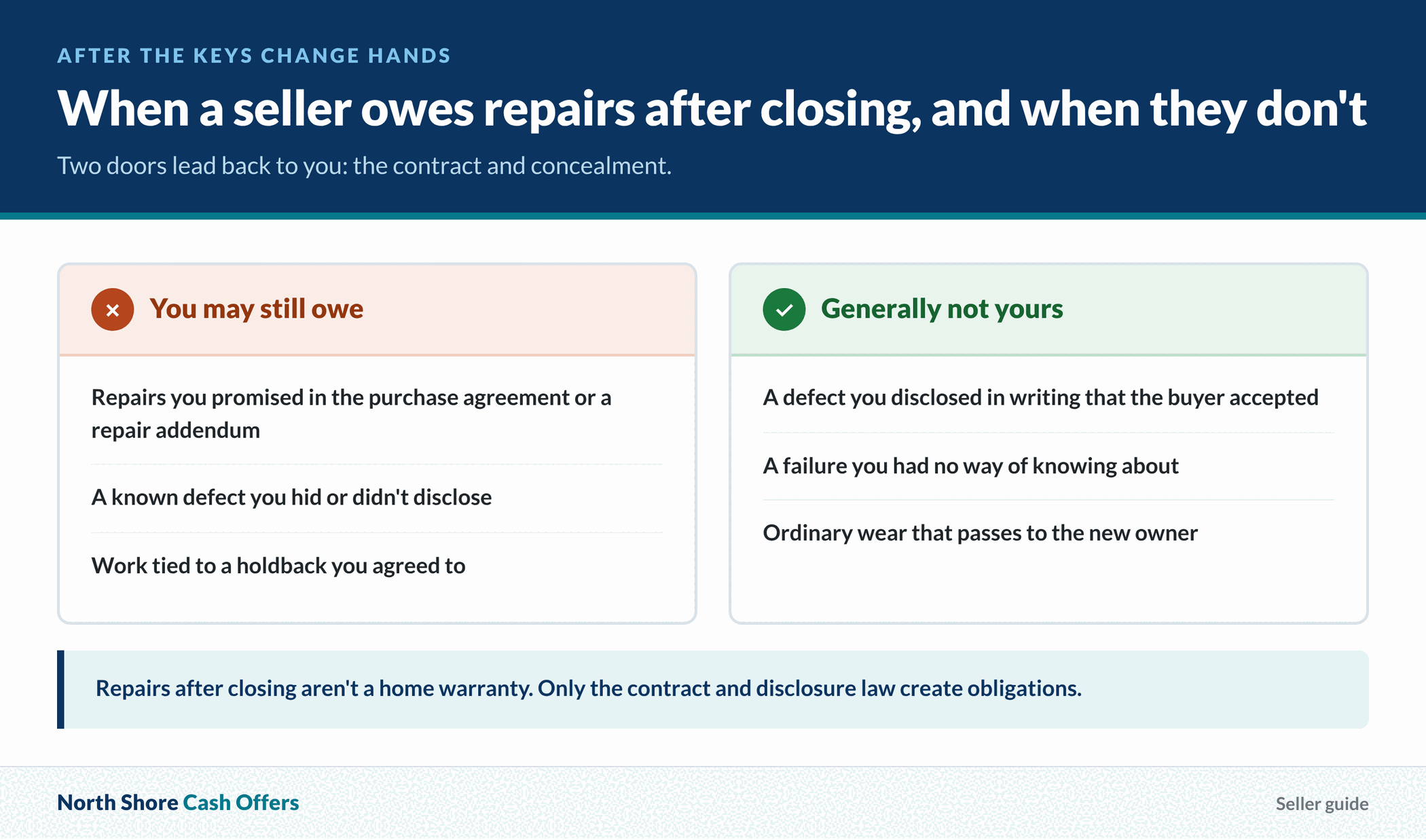
The default rule across the country is that once title transfers, the property’s condition belongs to the buyer. Redfin’s guidance on the topic puts it plainly: a seller isn’t on the hook for repairs after closing unless the purchase agreement says so or the seller hid a known problem. Two doors, in other words. Contract and concealment.
Signing a repair addendum promising to replace the water heater and never doing it means that promise doesn’t just evaporate at the closing table. A repair agreement your buyer accepted is legally binding, and skipping the work can count as a breach of contract, which opens the door to remedies up to and including a lawsuit.
Disclosure obligations are set state by state. There’s no single federal disclosure statute for residential real estate, though federal law does require lead-based paint disclosure. Even in caveat emptor states like Alabama, Arkansas, and Georgia, a seller still can’t commit fraud or actively hide known defects.
In practice, it plays out like this. Knowing the basement took on water every spring and saying nothing, those fixes may land back in your lap. But if the sump pump died a month after you moved out and you had no idea it was failing, that’s ordinary homeownership passing to its new owner.
Sellers settle problems by disclosing them, but they too often forget that. A defect you put in writing before the contract was signed, which the buyer then accepted, is generally not yours to fix later, because the buyer took the property knowing about it.
Common Scenarios Where Sellers Skip Repairs After Closing
“I told them about the crack in the foundation, so why am I getting an email about it?”
The most common version I hear is this, and usually the answer is that the buyer’s inspector described the problem differently than the seller did.
They go unfinished for ordinary reasons more often than shady ones. A contractor flakes out the week of settlement or a roofing crew can’t work because it rained for nine days straight. Permits take longer than the county said they would.
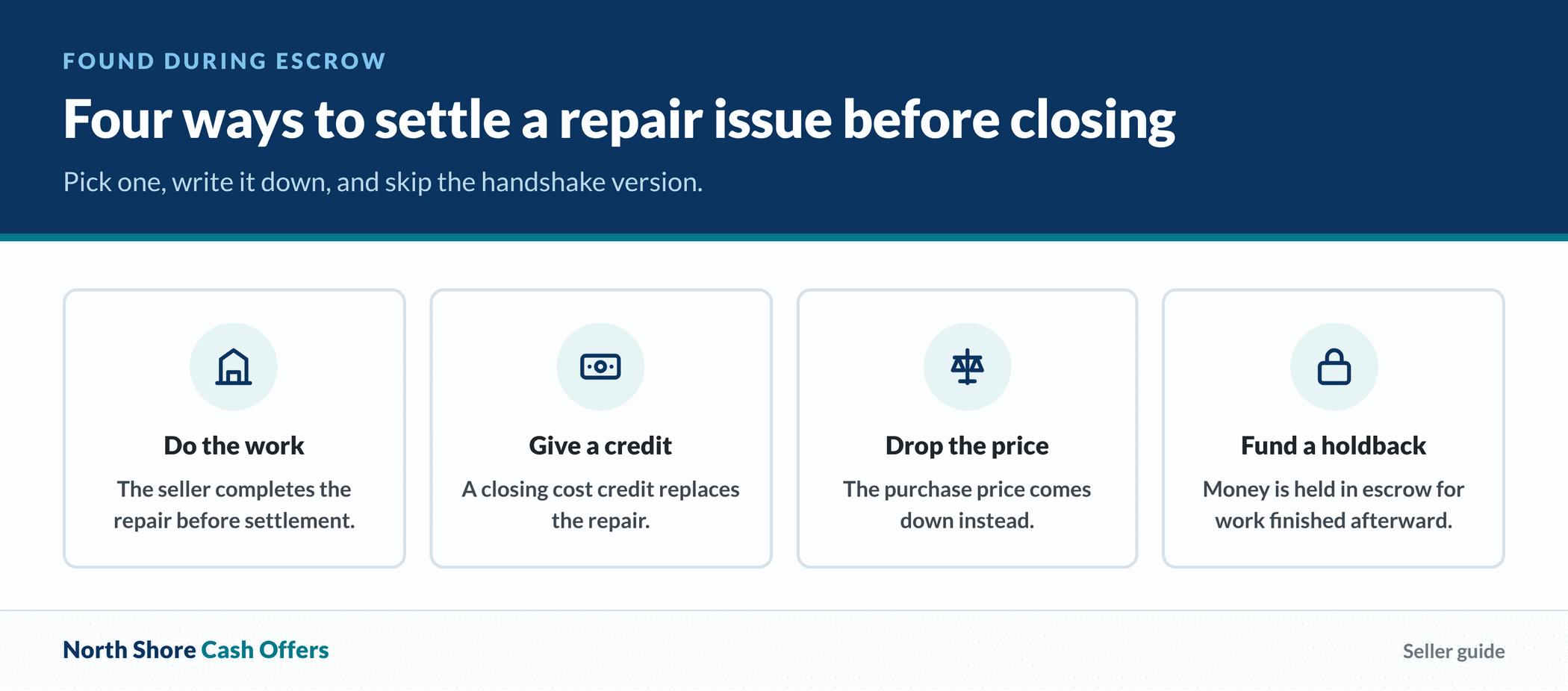
Then there’s the seller who genuinely believed a credit replaced the obligation. Price reductions, closing cost credits, and completed repairs are three different arrangements. A repair issue found during escrow typically ends in one of those outcomes: the seller does the work, gives a credit, drops the price, or funds a holdback for work finished afterward. Pick one. Write it down. Don’t do a handshake version of two of them.
A few years back, I bought from a widow who’d been quietly carrying two mortgages for close to a year after moving in with her daughter. Her listing agent had negotiated a plumbing repair she couldn’t afford and couldn’t schedule, and that single unfinished item had already killed one contract on a Thursday afternoon. We bought the house in its condition and she stopped writing two checks a month.
Selling as-is sidesteps most of this entirely, which is why some homeowners skip the repair-negotiation gauntlet and work with a direct buyer like North Shore Cash Offers instead. There’s no inspection addendum demanding work you can’t finance, and no argument about them, because nothing was promised in the first place.
How a Repair Holdback Protects You Until Closing Is Final
Every seller who agrees to post-closing work without a written cap on their liability is taking a risk they don’t need to take.
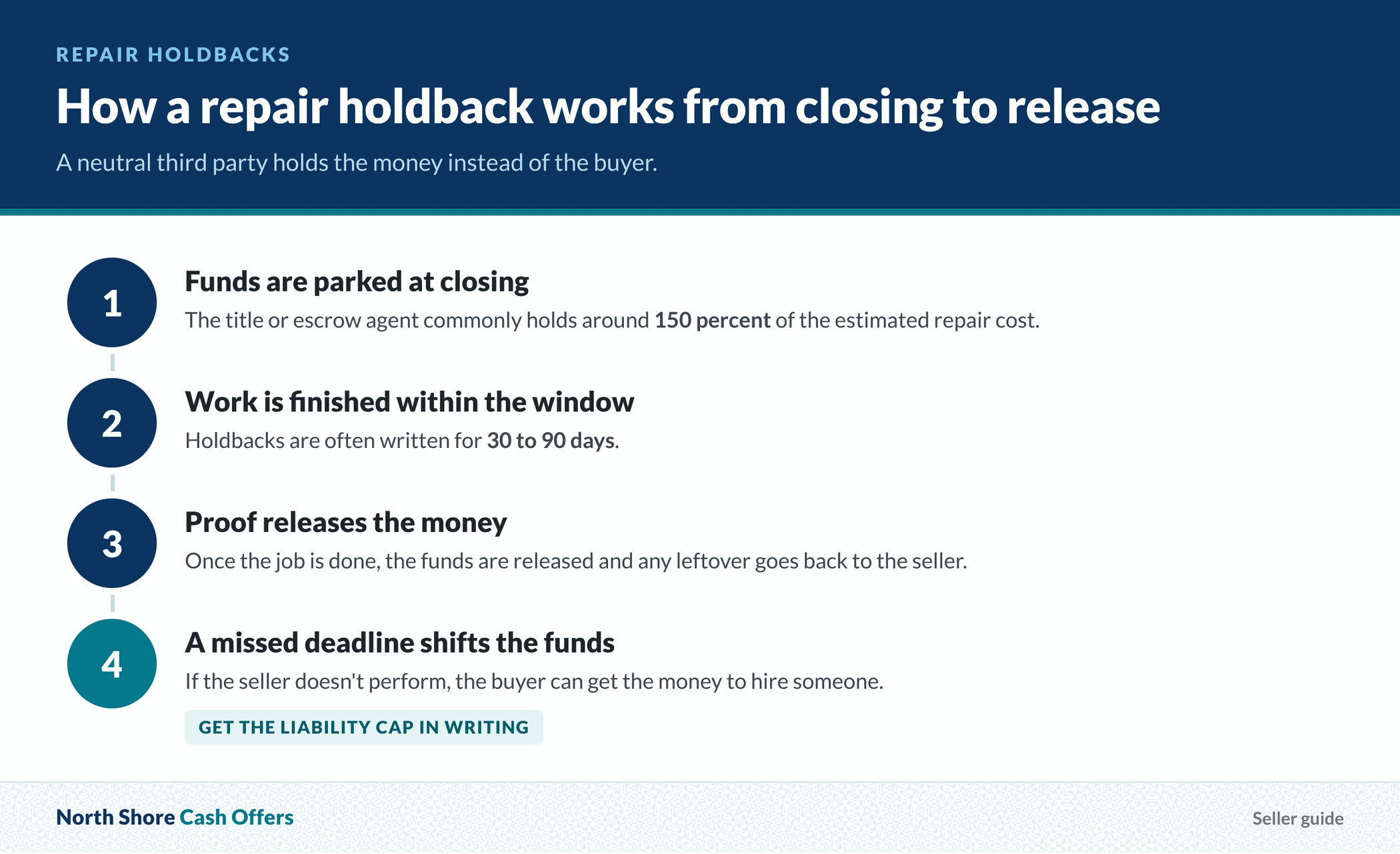
A holdback is the structured version of “I’ll finish it after we close.” Funds get parked with the closing or escrow agent and released once the remaining work is done. It’s a separately negotiated agreement among buyer, seller, and the escrow agent, plus the lender if the buyer’s financing.
How much gets held? The title company commonly holds around 150 percent of the estimated repair cost until the work is finished, and some agreements push that higher.
Sellers often forget to ask for one clause. If the real cost exceeds the escrowed amount, the seller usually owes the difference out of pocket unless the escrow agreement specifically caps liability at the holdback figure. Get that cap in writing. It’s one sentence, and it’s the difference between a known number and an open checkbook.
On the upside, money left over when the work comes in under budget goes back to the seller, so a generous holdback isn’t money lost. It’s money delayed.
Lenders complicate this. Not every lender permits a holdback arrangement, so it needs checking with the agents and the buyer’s lender before anyone signs.
Would you rather argue about it after closing with someone who already has your money, or settle it with a neutral third party holding the funds? That’s the whole case for a holdback, from either side of the table.
What Are Your Legal Rights When Repairs After Closing Are Ignored
“My buyer can’t really sue me over a leaking pipe, can they?” They can file something. Whether it goes anywhere depends on proof, and proof is a steep hill.
Holding a seller liable after closing generally means proving a breach of the contract, a failure to disclose what state law required, or fraud or negligence. A buyer’s attorney needs documents, inspection reports, emails, or testimony showing you knew. Suspicion isn’t evidence.
Your rights run both directions, and sellers forget the second direction exists. If a buyer withheld escrowed funds after you completed the work and documented it, you’ve got a contractual claim too. The majority of post-closing repair disagreements settle without litigation, usually because both sides run the math on attorney fees and lose their appetite.
Buyers must weigh timing limits as much as the merits, because missing a deadline can sink an otherwise solid claim. Deadlines for filing are set by each state and by the type of claim. Breach of a real estate contract commonly runs somewhere in the three to six year range depending on the state and whether the agreement was written or verbal. Fraud claims often run shorter, around two to four years, with a few states allowing longer. That spread is wide, so your state’s number is the only one that governs you.
Clocks don’t always start when you’d think. A breach claim usually starts running when the breach happens rather than when the damage gets noticed, though some states apply a discovery rule to latent or fraud-related breaches.
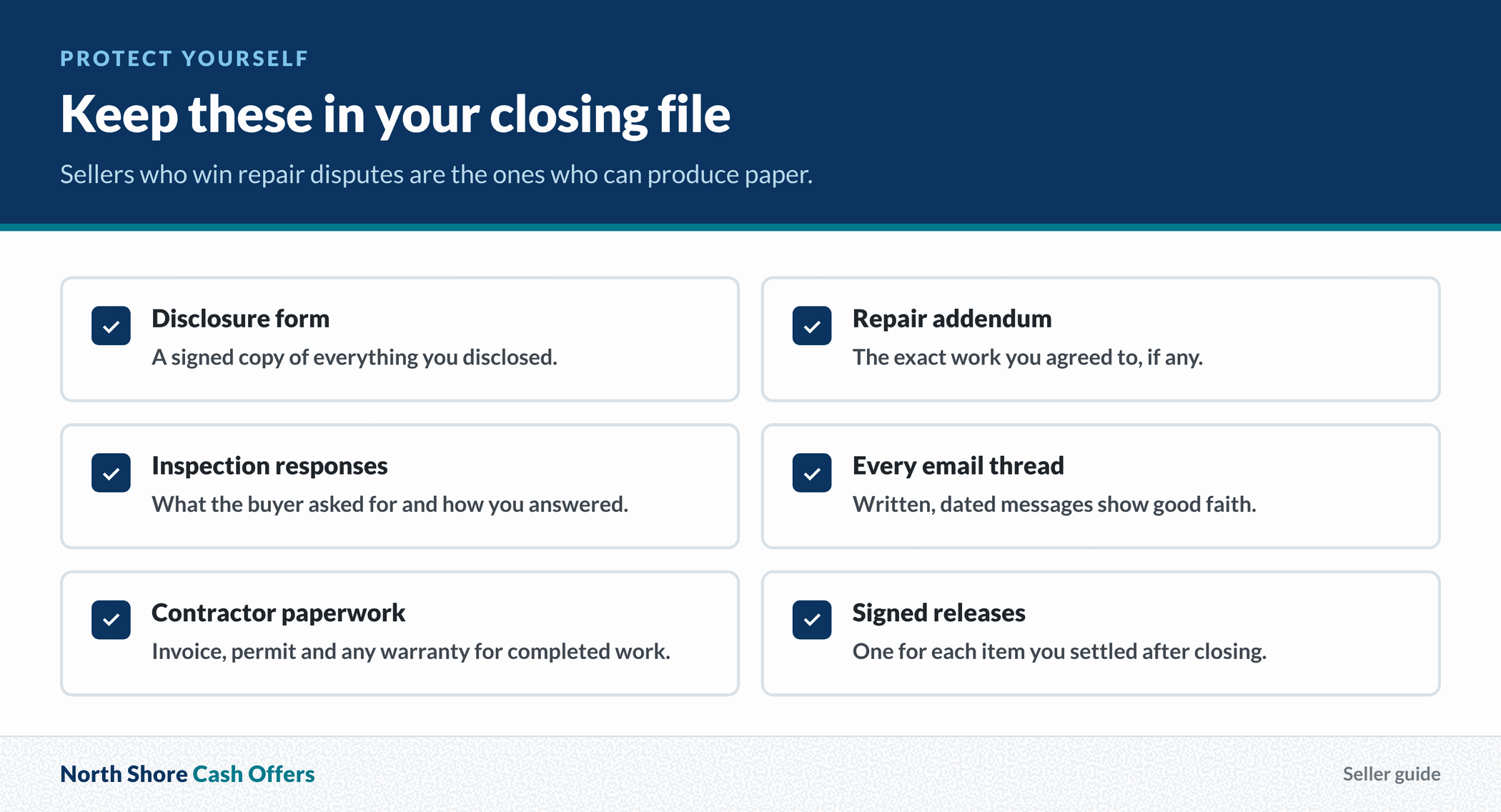
Keep your closing file. Disclosure form, repair addendum, inspection responses, every email thread. Sellers who win these disputes are the ones who can produce paper.
Immediate Options When Repairs After Closing Don’t Happen
A seller agreed to fix a failing HVAC system before settlement, but the contractor pushed the install three weeks and the closing date wouldn’t move. Rather than blow up the sale, the parties escrowed the money and the system went in nine days after the new owners took possession.
When repairs after closing stall, your first move is a written, dated message to the buyer explaining the delay and the new completion date, since silence reads as refusal. A paper trail showing good faith effort is worth real money if this ever gets serious.
Second, read your release terms. If the seller doesn’t finish the work, the release language in the holdback addendum controls what happens to the money. Some agreements convert unfinished work into a straight payout to the buyer after a deadline passes, so the buyer isn’t left chasing a contractor who never shows. Holdbacks are often written for a window of 30 to 90 days, and when the seller misses it with no sign of intent to perform, the buyer gets the funds to hire someone.
You can offer cash instead of coordination, usually the smartest option. Paying the buyer an agreed sum and getting a signed release ends the relationship cleanly.
If you’re the one receiving complaints about repairs after closing and you suspect the buyer is inflating a small issue into a big one, get your own estimate before you respond with a number. I’ve seen sellers volunteer four figures for problems a licensed tradesperson would fix for a fraction of that.
Don’t agree to anything verbally. Every resolution needs a signed release naming the specific item, or you’ll be back in the same conversation in six months.
Who Pays for Repairs After Closing Is Discovered Too Late
An out-of-state buyer opened a crawlspace four months after moving in and found mold along a joist. The seller, retired and living on a fixed income, got a letter demanding five figures for remediation.
What happens next depends only on what the seller knew and what the paperwork says. A seller with actual knowledge of a defect who chose not to disclose it doesn’t escape liability just because title transferred. Flip the facts, though, and a problem nobody knew about belongs to the new owner.
Age of the house doesn’t shift responsibility, and neither does the size of the bill. Buyers sometimes argue that a major expense must be somebody’s fault.
Buyers stretching to afford a home have no cushion left for surprises, which is how market conditions quietly raise the temperature on all of this. The national median existing-home price hit $416,700 in October 2026, up a slim 0.4 percent from a year earlier, marking 40 straight months of annual price gains. With mortgage rates around 7.3 percent that month, the marginal buyer had been completely squeezed out of the market. A buyer who emptied their savings to close has a strong incentive to send you a letter about repairs after closing rather than absorb the cost.
October 2026 unsold inventory reached a 5.1-month supply, the highest since November 2015, which hands buyers more room to push on condition during negotiations.
A quick reality check on expectations: repairs after closing aren’t a home warranty. No general rule obligates a seller to deliver a house in perfect working order. Only the contract and disclosure law create obligations, and everything else is the buyer’s to own.
When Repairs After Closing Problems Mean You Should Walk Away
Sellers picture the repair negotiation as one conversation and one check. Then the inspection report comes back eleven pages long, the buyer asks for roof work and plumbing and an electrical panel. Your contractor quotes six weeks out, and the lender wants proof of completion before funding. One conversation became a part-time job.
That’s the point where listing stops making sense for some people. Homes took a median of 35 days on market in October 2026, up from 33 in September, and that count starts before inspection, negotiation, and the closing timeline. Add repair scheduling to that and you’re months out, carrying taxes, insurance, and a mortgage the whole way.
Selling as-is to direct buyers removes the repair conversation completely. You don’t negotiate repairs after closing because you never negotiated repairs at all. Investor activity backs this up: investors and second-home buyers accounted for 20 percent of sales in October 2026, up from 16 percent a year earlier. A good share of those were houses nobody wanted to repair first.
I once worked with an heir whose mother had filled a two-story house with thirty years of belongings, including a garage so full of canning jars you couldn’t open the side door. Three siblings lived in three states and wanted one clean exit, not a summer of hauling and contractor bids. So we bought it loaded, they took what mattered, and the estate closed without a single repair addendum.
If the repair list is longer than your patience or your budget, an as-is offer from a buyer like North Shore Cash Offers puts a firm number in front of you. There are no inspection contingencies attached.
Frequently Asked Questions
What If the Buyer Won’t Release the Holdback After I Finish the Repairs?
Go back to the release language in your holdback addendum, because that’s what controls the money. Most agreements release the funds once you show proof the job is done, so send the escrow agent your invoice, any permit, and photos of the finished work. If the buyer still won’t sign off after you’ve documented the repair, you’ve got a contractual claim of your own. Bring that paper trail to a real estate attorney before the dispute drags on.
How Long Am I on the Hook for Repairs After Closing Once I’ve Sold?
There’s no single national cutoff. Your exposure ends when the filing deadline for the relevant claim runs out in your state, and that window differs depending on whether the buyer is alleging a broken contract promise or hidden defects. Since written-contract claims usually run longer than fraud claims, and some states extend the clock when a problem stayed hidden, check with an attorney licensed where the house is located.
Can a Seller Set Money Aside in Escrow to Cover Repairs?
Yes, and it’s often the cleanest way to close on time when work can’t finish beforehand. Part of your proceeds stays with the escrow or title agent instead of coming to you, and it’s released once you show proof the job is done. Make sure the agreement names the specific work, sets a completion deadline, and caps what you owe at the escrowed amount.
What If the Buyer Claims Repairs After Closing Were Done Badly?
Poor workmanship complaints are their own category, and they often belong to the contractor rather than to you. Pull the invoice, the permit if one was required, and any warranty the tradesperson provided, then send the buyer directly to that contractor. If you hired a licensed professional and paid for the work as agreed, your contractual obligation was generally satisfied.
Does Selling As-is Fully Protect Me From Repairs After Closing?
As-is language removes your duty to fix things, but it doesn’t cancel your duty to tell the truth. In nearly every state you still can’t conceal a defect you know about, even when the contract says the buyer accepts the property in current condition. Disclose everything you’re aware of, keep a copy of the signed form, and as-is will hold up the way it’s meant to.
Should I Hire a Lawyer If I Get a Demand Letter About Repairs After Closing?
An hour of an attorney’s time is cheap compared to responding wrong. Don’t admit fault, don’t promise payment, and don’t ignore it either, because silence can escalate a solvable disagreement into a filed case. Bring your closing file, your disclosure form, and any repair addendum to that first meeting so the attorney can tell you quickly whether the claim has legs.
If you’re sitting on a house that needs work you don’t want to manage, or you’re worried about what a buyer might come back to you with later, we’re happy to talk it through. Ask whatever you want, take an offer or don’t, and either way you’ll walk away knowing your options better than you do right now.
Repairs After Closing and North Carolina Sellers
North Shore Cash Offers buys houses throughout North Carolina, including the Charlotte area and the Triangle. NC REALTORS put the statewide median sales price at $368,990 in October 2026, with 5.98 months of inventory.
That much supply gives buyers time to ask for repairs before they’ll commit. You can skip that step, since we buy houses in Raleigh-Durham and across the state as-is, with nothing to fix before or after closing.
Ask Us About Selling Without a Repair List
If a repair request is holding up your sale, or you’re worried about a call after closing, you can contact North Shore Cash Offers and talk it through. We’ll see the house in its current condition and lay out your options. There’s no obligation either way. You can also fill out the short form below.
Helpful North Carolina Blog Articles
- Can You Sell A House With Mold In North Carolina
- Selling A House That Needs Repairs In North Carolina
- Selling a House with Water in the Crawl Space in North Carolina
- Can I Sell My House and Still Live in It
- Can You Sell a House With a Lien in North Carolina
- How Long Does a Real Estate Contract Last in North Carolina
- How to File a Quitclaim Deed on North Carolina Real Estate
- How to Sell a Fire Damaged House As-is in North Carolina Fast
- Selling a House During Divorce in North Carolina
- Should I Sell My House and Move to an Apartment
- Is the Seller Responsible for Any Repairs After Closing