
A hairline crack in a brick veneer wall costs almost nothing to seal. Photographed by a buyer’s inspector and typed into a report under the word “structural,” that same crack can knock five figures off your sale price. I’ve bought houses across the Piedmont for years. The gap between what foundation problems actually cost to fix and what buyers believe they cost is the single widest gap in North Carolina residential real estate. This guide walks through what the law requires, what inspections really catch, and how sellers get fair money without pretending the cracks aren’t there.
How Foundation Problems Affect Your Home’s Value in North Carolina
Sellers price a home with a cracked footing by subtracting the contractor bid from the market value. Clean math. It almost never works that way, because a buyer who sees foundation problems on a disclosure form stops doing arithmetic and starts doing fear. One engineer’s letter might say the settlement stopped a decade ago. Despite all that, the offer still comes in $30,000 under comps, not because of the repair, but because the buyer isn’t sure what else is hiding under the crawl space.
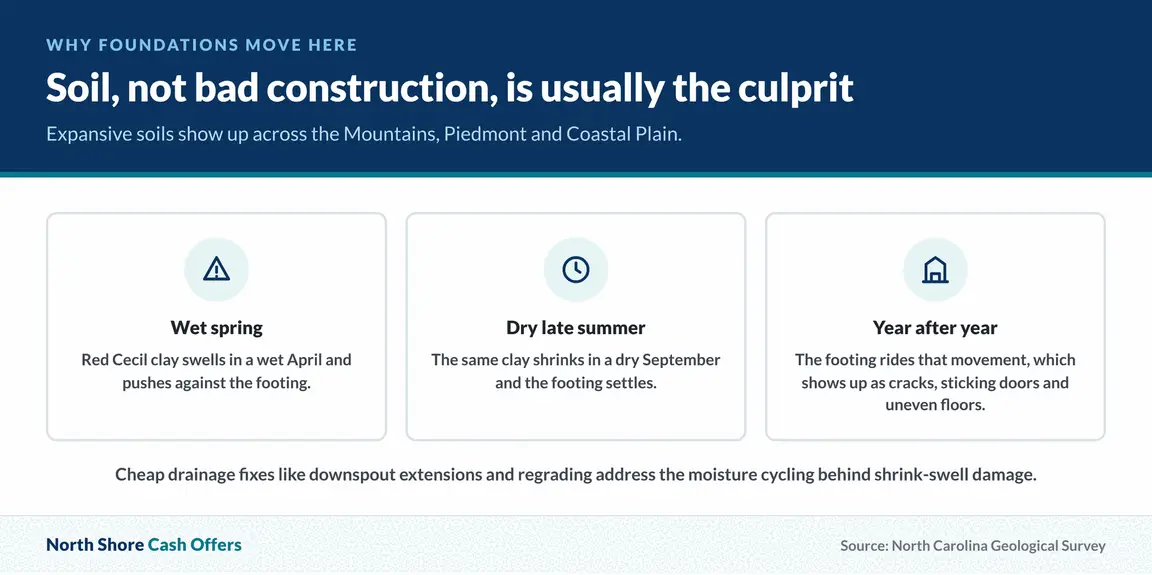
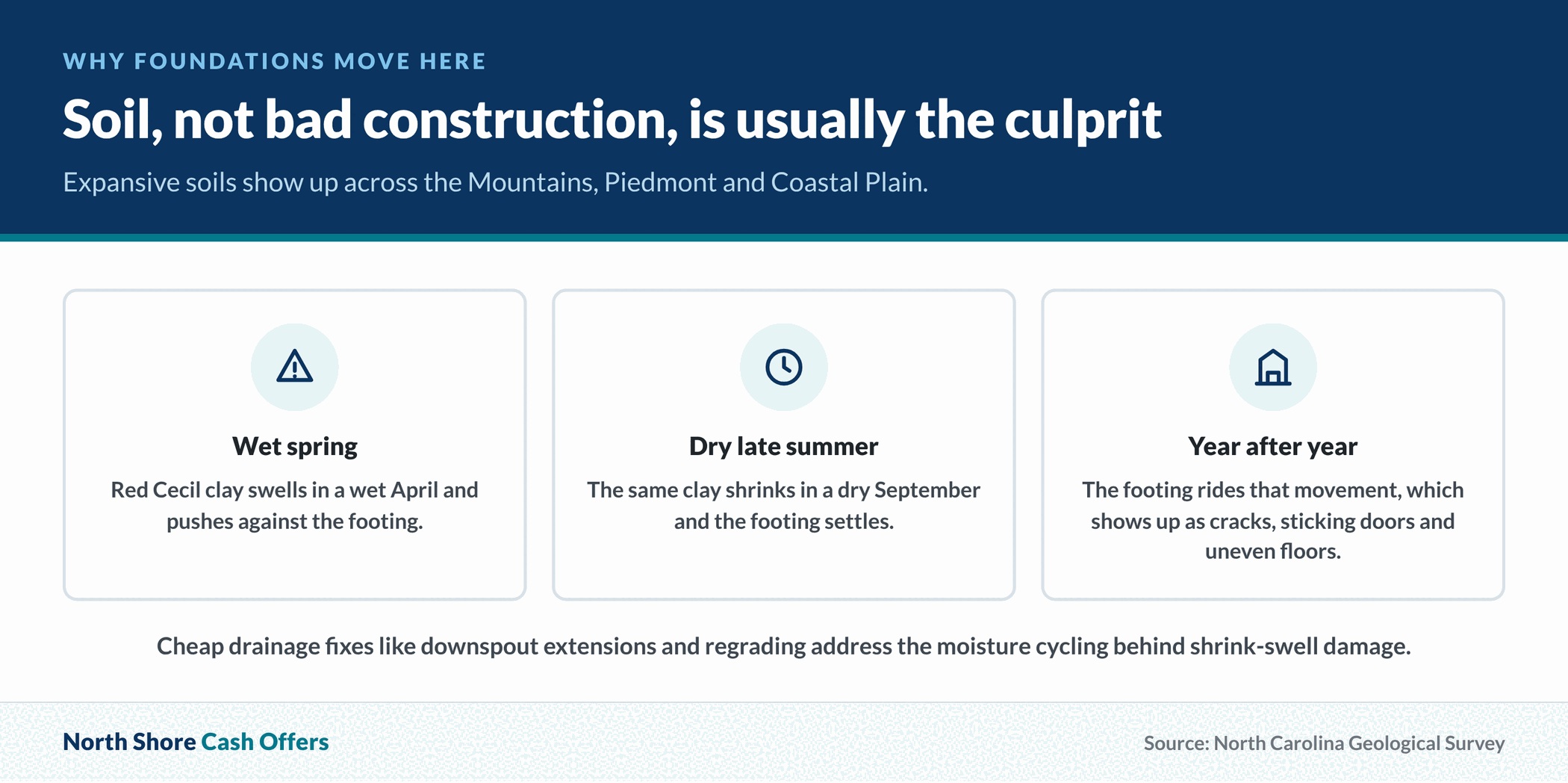
Soil is the culprit here more often than bad construction. The state geological survey points out that expansive soils show up almost anywhere in the Mountains, Piedmont, and Coastal Plain. The Triassic basins and the Carolina terrane see higher rates, and you can read the survey’s own breakdown on the North Carolina DEQ site. Red Cecil clay swells in a wet April and shrinks in a dry September, and the footing rides that movement year after year.
How hard that discount bites depends on where the market stands. Statewide, the typical home value sat at about $284,000 as of September 2026, with homes in the median ZIP code spending roughly 70 days on market. A home with visible foundation problems in a 70-day market doesn’t sell in 70 days; it sells in 120 or it sells to an investor.
It’s location, more than condition, that changes the picture. Wake County stays hot: Apex posted a median sold price near $630,700 in October 2026 with homes going under contract in about 54 days. A Durham bungalow with a sagging pier and a Rockingham County ranch with the same sag will get wildly different treatment from the buyer pool.
Not long ago I bought a rental from a landlord who needed to be out fast. His rental had a brick pier under the back bedroom that had dropped nearly an inch, and the garage was still full of tenant-left paint cans on a Tuesday when we walked it. He didn’t have time to chase bids, so he took a price that reflected the real repair rather than a buyer’s imagination.
What North Carolina Law Says About Disclosing Foundation Problems
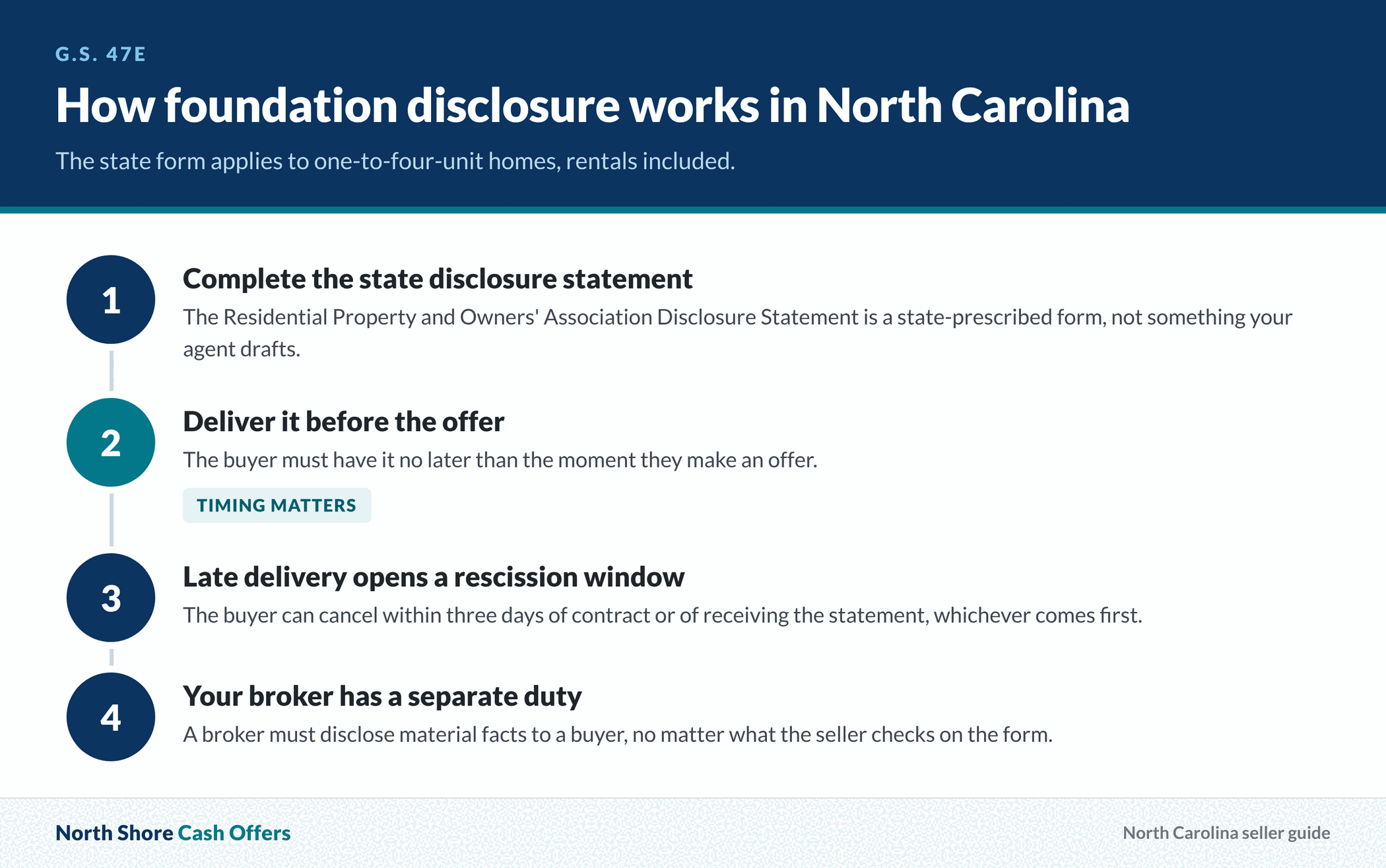
And that honesty wasn’t just decency, it was the statute. The Residential Property Disclosure Act, G.S. 47E, requires sellers of one-to-four-unit residential property to complete the Residential Property and Owners’ Association Disclosure Statement covering conditions and defects. The form’s a state-prescribed document, not something your agent drafts. You can pull the official version from the North Carolina Real Estate Commission.
Timing matters here as much as the form itself. Under § 47E-5, the disclosure has to reach the buyer no later than the moment they make an offer, so handing it over late just hands the buyer leverage. A seller who misses that window opens the door to the buyer rescinding within three days of contract formation or three days from receiving the statement, whichever lands first.
Where sellers trip up is the “no representation” column. Checking it isn’t a magic shield for foundation problems you already know about.
Brokers carry their own duty, separate from yours, and it stands no matter what the seller decides to disclose. A broker must disclose material facts to a prospective buyer. So if you tell your listing agent about the bowing basement wall and ask them to keep it quiet, you’ve just put their license at risk and done nothing for your own legal liability.
Investors sometimes believe rental property is exempt. Commission guidance is direct on this: a property being investment property and never owner-occupied doesn’t erase the seller’s duty to give the disclosure statement. The full statute text sits on the General Assembly’s site if you want to read Chapter 47E yourself.
My opinion, and some agents disagree with me: disclose the foundation problems in writing with more detail than the form asks for. Attach the engineer’s report. Attach the repair invoice if you have one. Transparency kills the buyer’s worst-case imagination, and that imagination costs far more than the truth does.
What Role Does a Home Inspection Play in Foundation Problems?
For my first few years buying houses, I treated a general home inspection as the final word on structure. That was wrong, mostly because I didn’t yet understand what these inspectors are actually trained to do. They flag the symptom (a door that won’t latch, a diagonal crack over a window, a crawl space with standing water). Then they write the sentence every seller dreads: recommend evaluation by a licensed structural engineer.
That referral sentence is where sales stall out. The buyer reads it as “this house is broken.”
Here’s where sellers lose control. If the buyer’s inspector is the first person to name the foundation problems, the buyer owns the narrative, the engineer, and the repair bid. Negotiation tactics from there are predictable: the buyer’s agent brings one eye-popping quote and asks for a credit.
Would you rather get a report you commissioned or react to one you didn’t? A pre-listing inspection paired with a structural engineer’s letter flips the dynamic. You pick the expert, you get the real scope, and you hand homebuyers documentation instead of a mystery. Engineers in the Triangle and the Triad regularly write letters confirming that movement is old, stable, and not progressing. That letter is worth more than many repairs.
Crawl space homes dominate older North Carolina neighborhoods, from Dilworth in Charlotte to Oakwood in Raleigh, and crawl spaces hide a lot. Moisture, failed vapor barriers, rotted sill plates, sagging girders. I’ve seen inspections in those homes run long and surface more items, so budget for a longer due diligence period.
One pattern I keep seeing: sellers fix the cosmetic cracks right before listing and leave the cause alone. This means fresh drywall mud over a stair-step crack reads as a cover-up to any inspector who’s been doing this a decade. It poisons trust for the rest of the transaction. Patch after you address drainage, never before.
Should You Fix Foundation Problems Before Selling Your North Carolina Home?
A seller in Hickory called me after getting three bids on a settled corner of her 1960s ranch. The low bid still exceeded what she’d budgeted for her move, and she’d already put a deposit on an apartment near Lake Hickory.
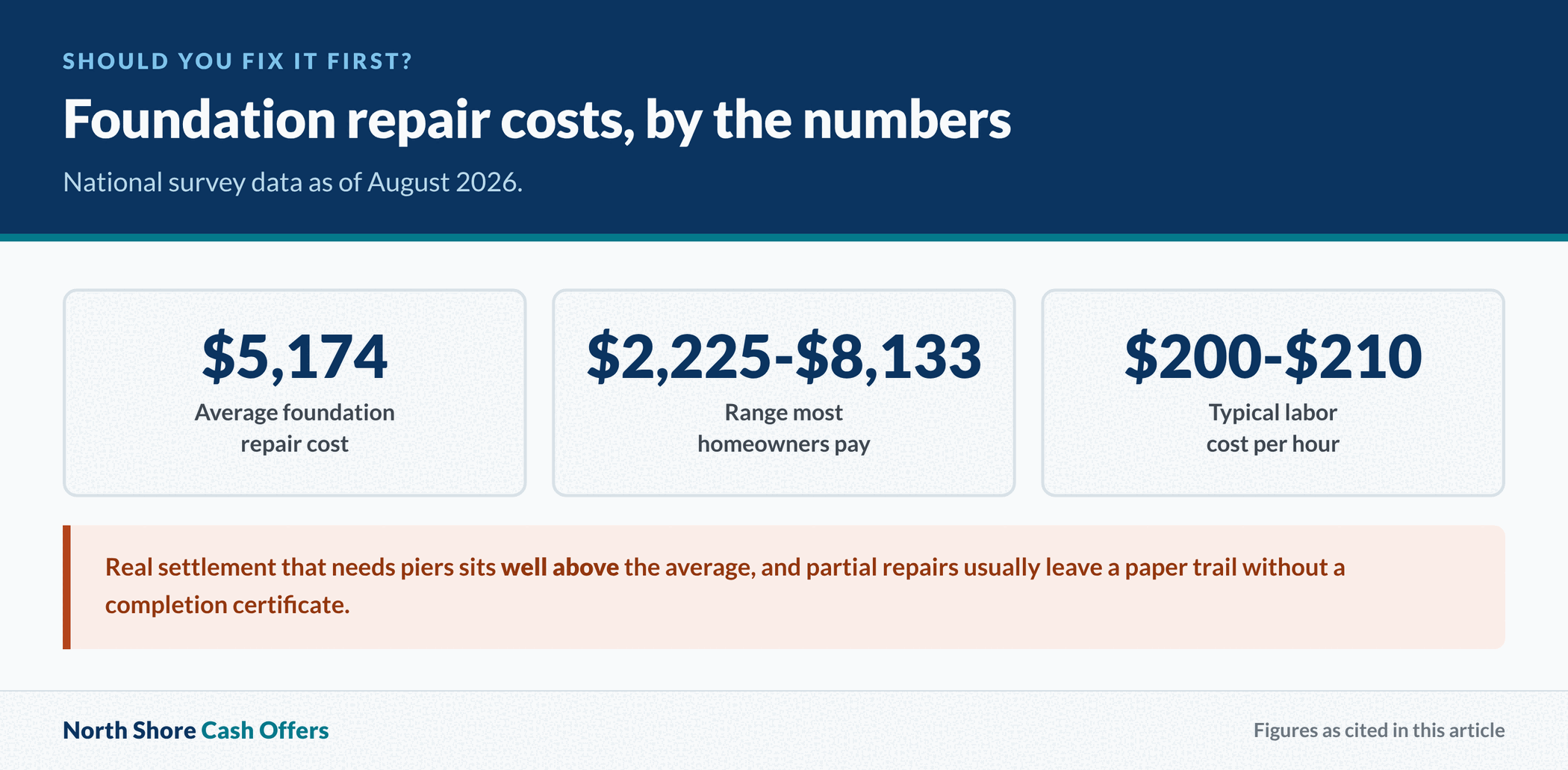
Expectations and reality tend to split on cost. National survey data as of August 2026 puts the average foundation repair at $5,174, with most homeowners landing between $2,225 and $8,133, and labor running roughly $200 to $210 per hour. Those figures cover everything from crack injection to moderate structural work. Real settlement requiring piers sits well above that average.
So should you write the check? My answer depends on one question: does the repair have to happen before a lender will fund a loan? Conventional and FHA underwriters get nervous about active structural movement, so if a bank won’t lend on the house, your buyer pool shrinks to cash buyers and investors no matter how you price it.
Partial repairs are usually a waste of money. Spending $4,000 on half a job gives you a paper trail documenting foundation problems without a completion certificate to offset it.
Drainage work, on the other hand, is the exception I recommend constantly. Extending downspouts, regrading a negative slope, clearing a clogged French drain: it’s cheap, fast, and it addresses the moisture cycling that the state’s geologists describe as the actual mechanism behind shrink-swell damage. You can see their mitigation notes on the DEQ geologic hazards page.
Warranties matter too. Most reputable North Carolina foundation contractors issue a transferable warranty, and that transferability is worth negotiating for because it travels to the buyer and quiets a lot of anxiety. Ask before you sign, not after.
Is It Better to Sell As-is with Foundation Problems in North Carolina?
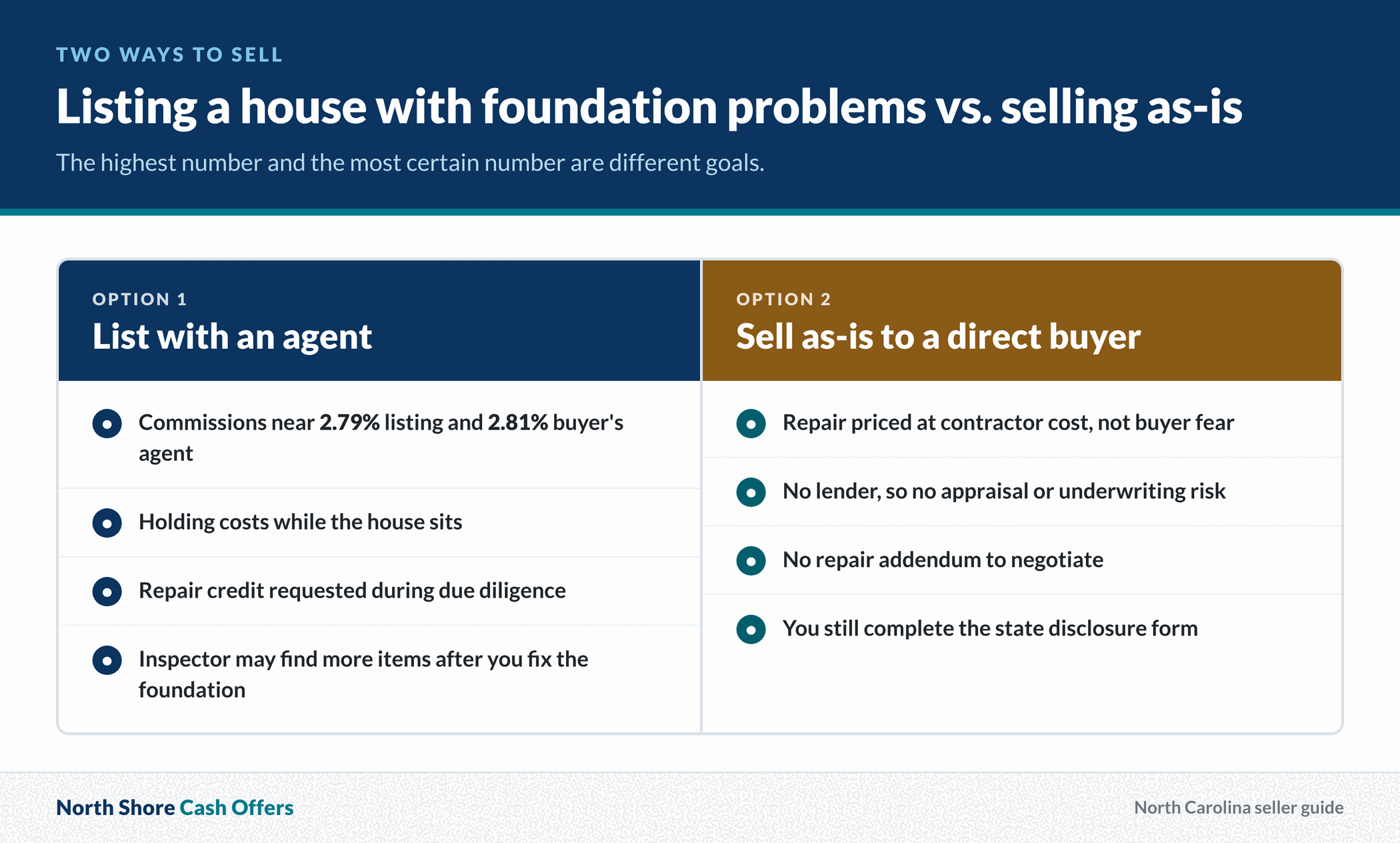
For most sellers facing real structural work, as-is is the better financial decision, and I say that as someone who profits from it, so weigh it accordingly.
Running the numbers honestly helps. List with a realtor and you’ll pay commissions on both sides, which in North Carolina run around 2.79% to the listing agent and 2.81% to the buyer’s agent. Add holding costs for the months a compromised house sits, plus the repair credit the buyer will demand anyway during due diligence.
Then there’s the second round of negotiation nobody warns you about. You fix the foundation problems, you list at full market value, and the buyer’s inspector finds the HVAC, the roof, and the water heater. Repairing one system doesn’t immunize you from the rest.
Investors price differently from retail homebuyers. We’re buying the repair at contractor cost, not at the emotional cost a family attaches to a “structural” label. That’s why an as-is offer on a house with foundation problems often lands closer to a discounted listing price than sellers expect. Companies like North Shore Cash Offers buy in this condition regularly and close without lender involvement, which removes the appraisal and underwriting risk entirely.
What are you optimizing for, the highest number or the most certain one? Those are different goals, and plenty of sellers chase the first while their situation demands the second.
As-is doesn’t mean undisclosed. You still complete the state disclosure form, you still answer honestly, and the as-is clause in the contract addresses repairs, not your legal liability for non-disclosure. Sellers conflate those two constantly, and it’s an expensive mistake.
Can You Sell a House with Foundation Problems in North Carolina?
“Will anyone even buy this?”
Yes. Houses with foundation problems trade every week across the state, from Asheville’s hillside craftsman homes to coastal cottages in Carteret County. The buyer pool narrows; it doesn’t vanish.
Cash buyers and renovation investors make up the bulk of that pool. Some retail homebuyers will take it on too, especially those using a renovation loan product, though those financings add weeks to closing. If a seller has time to wait, they can absolutely find a retail buyer willing to handle the repairs themselves at a negotiated discount.
You’ve got some room to work with on timing right now. Statewide, properties have been averaging 51 to 65 days on market before going under contract in 2026, which is a balanced market rather than a punishing one. Inventory hasn’t flooded, and buyers still show up for well-priced property even with known defects.
Pricing strategy is simple. Price for the condition, disclose everything up front, and provide documentation. Homes with foundation problems that fail are almost always homes priced as if the foundation problems don’t exist.
A seller in Shelby I worked with had a contractor’s estimate for her kitchen that came in higher than what the entire kitchen could possibly add to the home’s value. She also had foundation settlement under the back addition on top of it. The 1970s wallpaper was still up, there was a chest freezer in the garage that hadn’t run since the Obama administration, and she’d been quietly dreading the whole project for three years. She sold as-is in under a month and stopped losing sleep. If you want to run your own numbers against a direct offer, North Shore Cash Offers will walk the property and give you something concrete to compare against a listing.
Frequently Asked Questions
Get this part wrong and you’ll either sit on the market for months or sign a contract that falls apart during due diligence. These are the questions sellers ask me most.
Can You Live in a House with Foundation Issues?
In most cases, yes. Slow settlement from clay soil movement typically produces cosmetic cracking, sticking doors, and uneven floors long before anything approaches a safety concern. Severe bowing of a basement wall, active separation of a structural member, or a sudden change is different, and that warrants a structural engineer’s visit quickly. A licensed engineer can tell you in one appointment whether you’re looking at a monitoring situation or an occupancy risk.
Do I Have to Tell Buyers About Foundation Problems in North Carolina?
If you have actual knowledge of foundation problems, you disclose them on the state form, and the obligation applies whether the house is your residence or a rental you’ve never lived in. Selling as-is doesn’t cancel that duty; the as-is language covers who pays for repairs, not whether you told the truth. Hiding known defects is how sellers end up in lawsuits years after closing, and a few thousand dollars of disclosed damage is far cheaper than defending a claim.
Will a Buyer’s Lender Refuse a Loan Over Foundation Problems?
Sometimes, and it depends on severity. Underwriters generally want assurance that the structure is sound and that movement isn’t ongoing, so an engineer’s letter confirming stability often satisfies them. Active structural failure usually does kill conventional and government-backed financing, which pushes you toward cash buyers or renovation loan products.
How Much Value Do Foundation Problems Take Off a North Carolina Home?
There’s no clean formula, but buyers almost always discount more steeply than the repair bid justifies. Documentation narrows that gap more than anything else you can do. An engineer’s report, contractor bids, and a transferable warranty on any completed work turn an unknown into a number, and buyers pay more for a known number than an open question.
Should I Get Multiple Repair Bids Before Listing?
Get at least three, even if you intend to sell as-is. Bids vary enormously because contractors propose different scopes for identical symptoms, and the spread tells you something useful about what the real problem is. Those quotes also become your negotiation ammunition when a buyer shows up waving one inflated estimate.
Is Spring or Fall a Better Time to Sell with Foundation Problems?
Spring brings more buyers, but it also brings the wet season when crawl spaces show standing water and cracks look their worst. Late summer and early fall often present the property more favorably in the Piedmont, since the soil has dried and drainage issues are less visible. Don’t let that timing tempt you into concealing anything; it just means the house photographs and inspects better.
If you’re sitting on a house with foundation problems in North Carolina and you’re not sure whether to fix it, list it, or sell it as-is, I’m happy to talk it through. Bring your inspection report, your contractor bids, or nothing at all. We’ll go over the numbers together, and if listing with an agent serves you better than a direct sale, I’ll tell you that straight. No pressure, no obligation, just a real conversation about what makes sense for your situation.
Foundation Problems and the North Carolina Market Right Now
North Shore Cash Offers buys houses all over North Carolina, cracked footings and sagging piers included. NC REALTORS put the statewide median sales price at $368,990 in October 2026, with 5.98 months of inventory on the market. Buyers in a balanced market like that can afford to be picky about structure. If that’s the conversation you’d rather avoid, you can sell your North Carolina house as-is and let us handle the foundation work after closing.
Get a Straight Answer on Your House With Foundation Problems
You don’t need an engineer’s letter or a stack of repair bids to start. Just reach out to North Shore Cash Offers and tell us what you know about the foundation. We’ll see the house as it is, and there’s no obligation to sell. You can also use the short form below when it suits you.