
A house worth four hundred thousand dollars can skip the clerk’s office entirely. A checking account with eleven thousand dollars in it might not. Almost every family I talk to is confused by that upside-down math, and it’s the single biggest reason people guess wrong about whether probate applies to them in North Carolina.
I’ve bought houses from heirs in Winston-Salem, from siblings in Gastonia, from a widow outside Boone. Most of them walked in believing the value of the home decided everything. It doesn’t.
What Is Probate in North Carolina?
For years I told sellers that probate was a judge’s courtroom process, and that was wrong. In North Carolina, probate is handled by the Clerk of Superior Court in the county where the person lived at death. No black robe, no gallery, no jury. You’re dealing with a clerk’s estates division, and the people behind that counter are generally helpful if you show up organized.
Probate is the court-supervised process of administering a deceased person’s estate. Somebody has to gather the assets, give notice to creditors, settle valid debts, and hand what’s left to the heirs or beneficiaries named in the will. That person is the personal representative: an executor if a will exists, an administrator if one doesn’t.
People get tripped up by the word itself. Probate technically means proving the will is genuine. In everyday use around here, probate covers the whole administration: the filings, the inventory, the creditor notice, the final accounting.
Not every asset enters probate. Life insurance with a named beneficiary, a 401(k), a jointly owned bank account, a property held in a revocable living trust: those pass outside the probate estate on their own. What’s left in the decedent’s name alone is what the probate process touches.
Early last year a longtime landlord in Kannapolis called me about a rental he’d held for two decades, three months behind on the mortgage with an auction date already circled on the calendar. His mother’s name was still on the deed, she’d passed, and nobody had opened probate. We worked the estate filing and the sale on parallel tracks and killed the auction date with a week to spare.
How Much Does an Estate Have to Be Worth to Go to Probate in North Carolina?
Guess low on this threshold and you’ll file the wrong form, lose six weeks, and start over. Guess high and you’ll pay for a full administration you never needed.
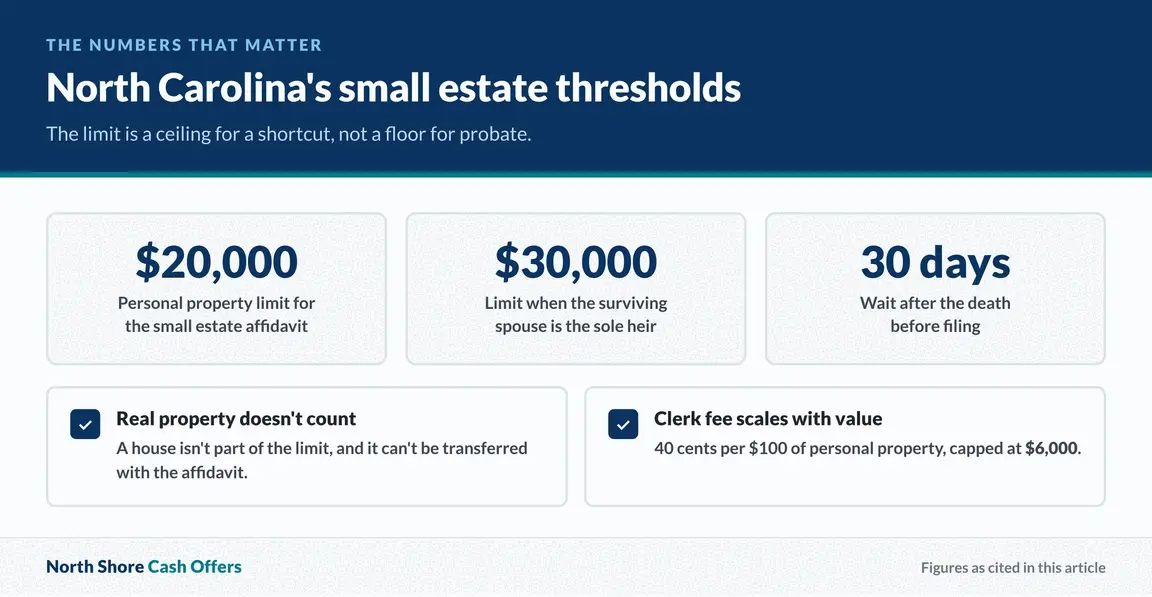
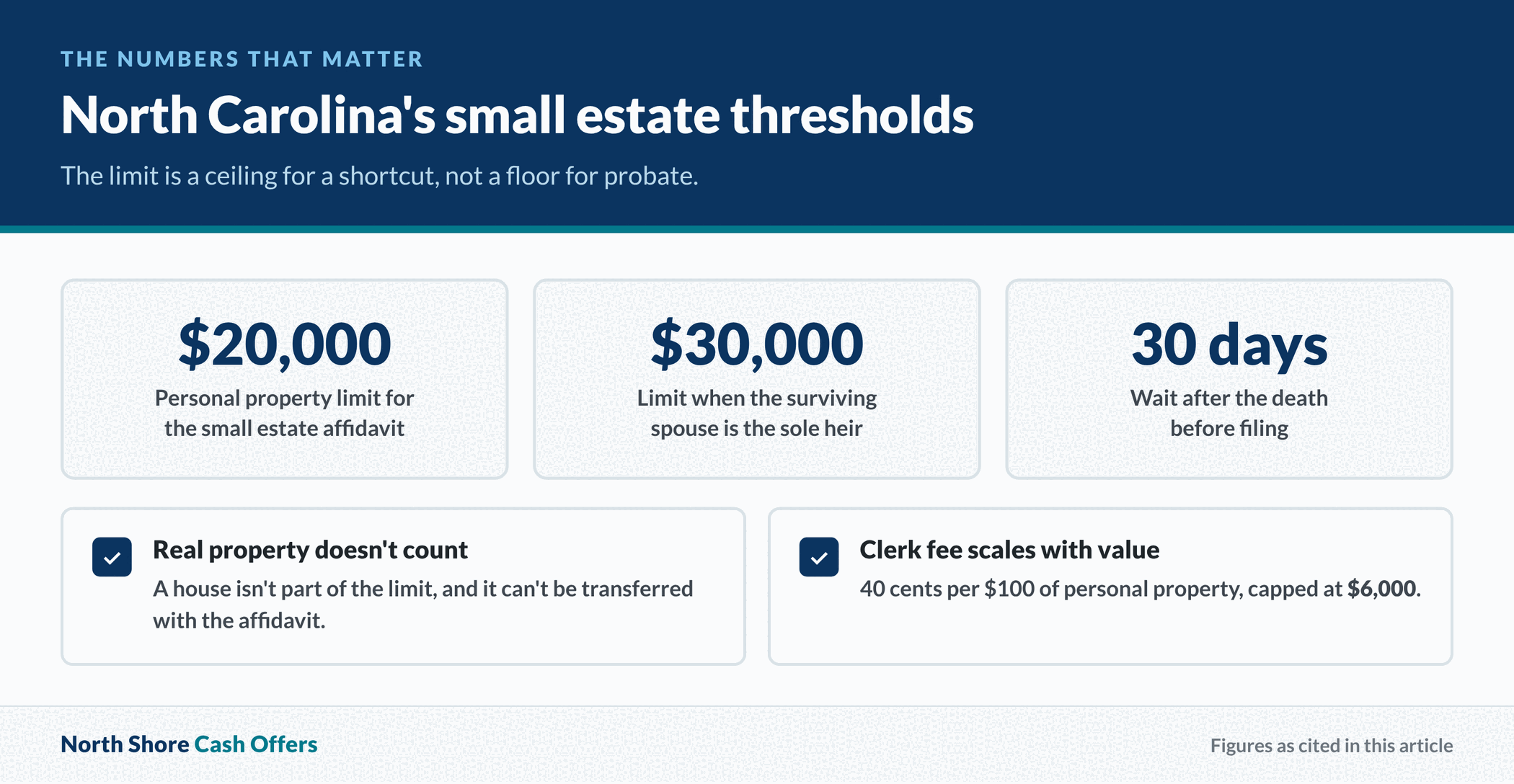
North Carolina offers a simplified small estate affidavit for personal property estates valued at $20,000 or less, or $30,000 if the surviving spouse is the sole heir. Liens and encumbrances are subtracted before that figure is measured, so you have to wait 30 days after the death before filing with the Clerk of Superior Court.
Read that word “personal” twice. Bank accounts, vehicles, furniture, tools, a boat are covered by the small estate affidavit. The small-estate affidavit pathway in North Carolina excludes real property. So a house doesn’t count toward the twenty thousand, and it also can’t be transferred using that affidavit.
Does an estate have a minimum dollar value before probate kicks in? Not in the way most people mean. North Carolina doesn’t set a floor below which the probate process is forbidden; it sets a ceiling below which a simpler shortcut is permitted.
Cost scales with value, and that part is statutory. The clerk collects 40 cents for every $100 of personal property passing through the estate, which comes to 0.4 percent, and that charge is capped at $6,000 no matter how large the estate gets. For clerk-fee purposes, the gross estate counts personal property plus proceeds from real estate that’s sold, but it doesn’t count real property passed directly to heirs. You can read the breakdown at this North Carolina probate cost explainer.
Does Real Estate Have to Go Through Probate in North Carolina?
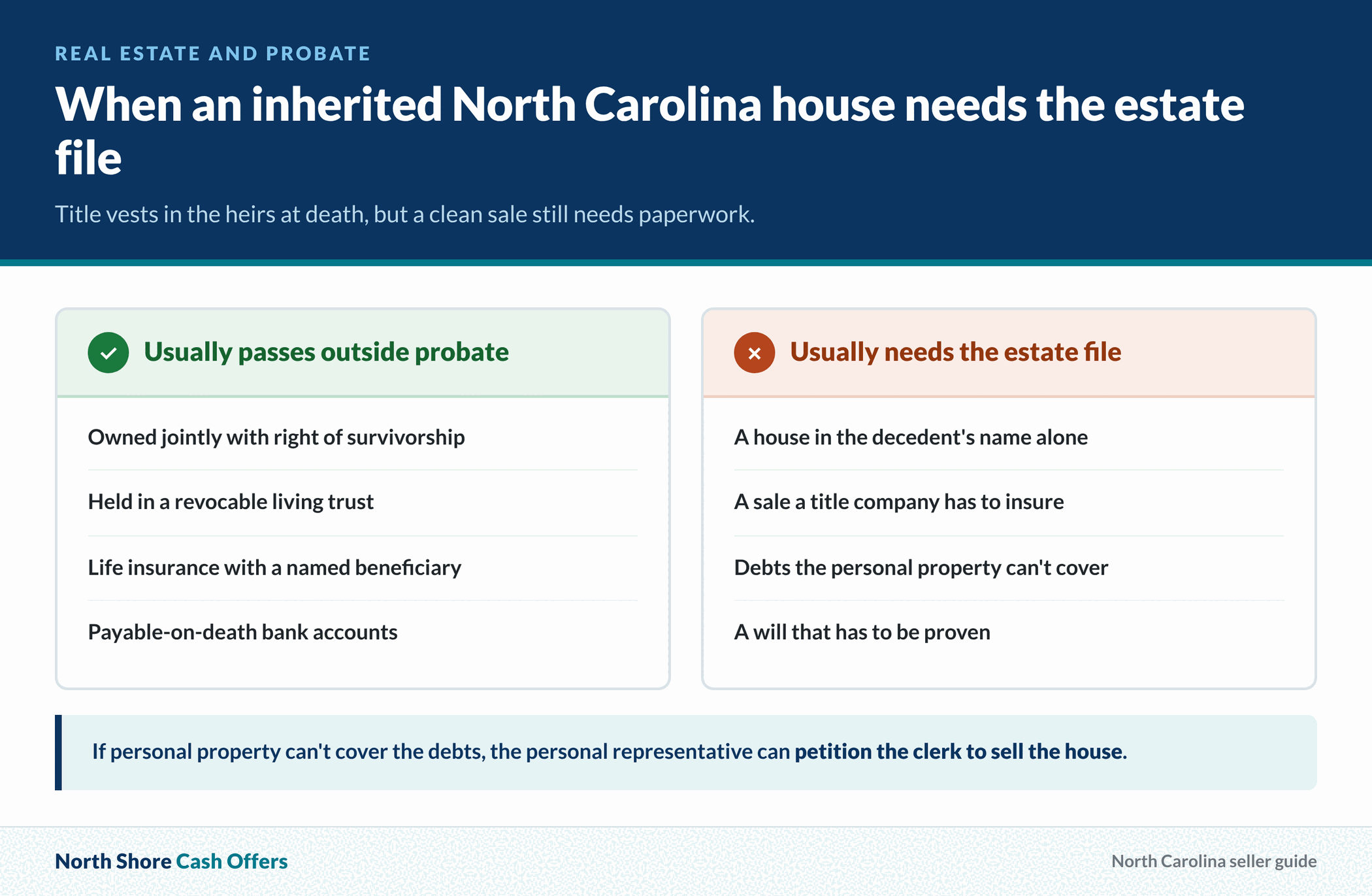
So the distinction between personal property and real property is where the probate question gets genuinely interesting for homeowners. Title to North Carolina real estate vests in the heirs or devisees at the moment of death, not when the clerk signs something. The house already belongs to somebody.
Sellers should still care about probate for good reason. A title company won’t insure a sale when the chain of title runs through a dead person with no estate file. The probate record is the paperwork proving who inherited and that creditors got their shot.
A home owned jointly with right of survivorship passes straight to the surviving joint tenant, and it’s the same story with a property sitting inside a revocable trust the owner set up during life. Those skip probate administration, and I’ve closed plenty of sales where nobody ever opened an estate.
Where the probate process grabs the house is debts. If the personal property can’t cover the decedent’s obligations, the personal representative can petition the clerk to sell the real estate to raise money for creditors. Buyers and title attorneys care about the creditor period for this reason, even when the deed looks clean.
Sellers are feeling pressure from market timing on top of all this. North Carolina inventory sat at 5.98 months in October 2026 with year-over-year sales volume down 19 percent, and the statewide median sales price eased to $368,990 per NC REALTORS. A balanced market gives heirs room to breathe. It doesn’t pay the taxes or the insurance while the probate file sits open.
Can You Avoid Probate in North Carolina?
“My mother had a will, so we’re fine.” I hear that at kitchen tables constantly, and it’s backwards, because a will is an instruction manual for probate, not a bypass around it. Testamentary documents tell the clerk who gets what; they don’t remove the estate from the clerk’s oversight.
What genuinely avoids probate is ownership structure set up before death. A revocable living trust holds title in the trust’s name, so there’s nothing in the decedent’s sole name to administer. Joint tenancy with survivorship does the same job for couples. Payable-on-death designations handle bank accounts and retirement money.
Could you skip the probate process after someone’s already gone? Occasionally, yes. Summary administration is available in North Carolina when the surviving spouse is the only heir or devisee and agrees to assume the estate’s debts. A narrow door, closing fast when there are children from a prior marriage.
My honest opinion on probate avoidance: it’s oversold to people who don’t need it. A modest estate with one house and two kids who get along will move through the clerk’s office without drama. Paying for an elaborate estate plan to dodge a small fee on personal property is poor arithmetic for a lot of North Carolina families.
Planning does earn its keep when there’s real estate in multiple states, a blended family, or a business. Those estates get expensive and slow inside probate administration. That’s where the attorney fees stop feeling like a luxury.
How Do You Start the Probate Process in North Carolina?
Where do you even begin? Waiting for the “right time” to open probate costs families more money than any mistake I see. Mortgage interest accrues. Homeowner’s policies get downgraded to vacant coverage or canceled. Pipes freeze in Boone and Banner Elk while everyone’s still deciding.
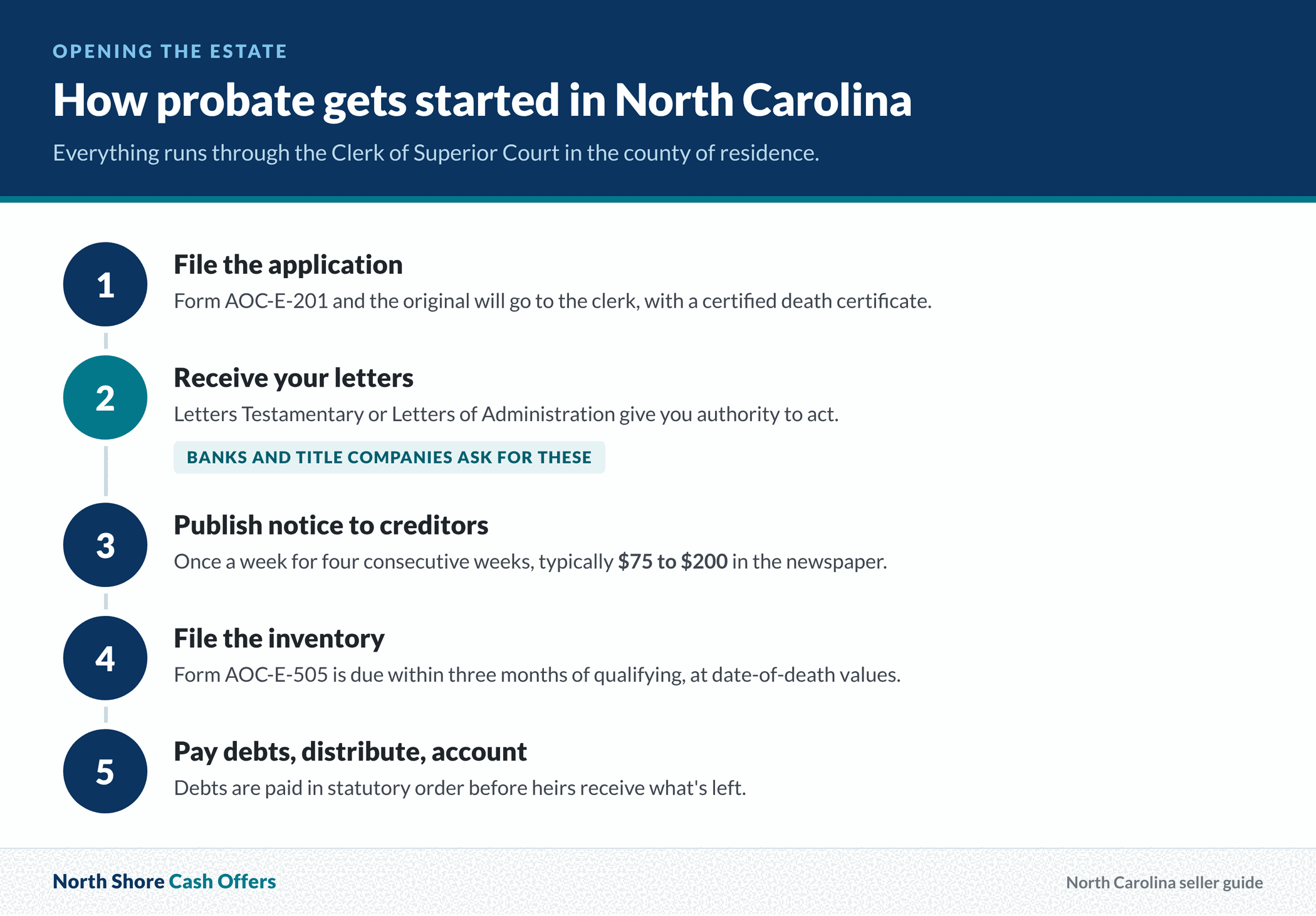
Start at the county clerk’s estates division where the decedent was domiciled. The will and the Application for Probate and Letters, form AOC-E-201, get filed with the Clerk of Superior Court. You’ll bring a certified death certificate, so make sure you’ve got that in hand, and the clerk reviews your application before issuing letters.
Letters Testamentary (with a will) or Letters of Administration (without one) are the document that gives you authority. Banks want to see them. Title companies want to see them. Until the clerk issues them, you’re a relative with opinions, not a personal representative.
Costs at the counter are modest to open. Section 7A-307 sets the clerk’s estate administration fee at $106 plus the per-hundred levy on the gross estate, plus a facilities fee. Publication of the creditor notice runs extra; four consecutive weeks of notice typically costs $75 to $200 depending on which newspaper you use.
Bring more cash than you expect to need. A clerk sending you home for a missing document costs you another trip, and in the bigger counties that’s a half day.
What Documents Does Probate Court in North Carolina Require?
So what paperwork does the clerk actually want to see? Pull out a shoebox and start collecting before you drive downtown; the probate process runs on paper, and scattered paper is what stalls estates. Certified death certificates come first, and order several, because the bank, the insurer, the clerk, and the DMV each want their own.
The court wants the original will, not a photocopy. Clerks here want the signed original lodged with the court. If you can’t find it, tell the clerk early rather than improvising.
Your application needs the heirs’ names and addresses, a preliminary list of assets, and your own information as proposed personal representative. Within three months of qualifying, the personal representative files the estate inventory, form AOC-E-505, which lists every probate asset at its date-of-death fair market value. That inventory deadline sneaks up on people who think the hard part ended at qualification.
Real estate appraisals belong in that inventory when a house is involved. A date-of-death valuation protects the heirs on the tax basis side and protects the personal representative if anyone later questions a sale price. I’d rather see a family spend a few hundred on a real appraisal than defend a Zillow screenshot.
Deeds, mortgage statements, property tax bills, and the homeowner’s policy round out the file for any estate holding North Carolina real estate. Keep receipts for everything the estate pays. The final accounting asks you to show your work, and reconstructing a year of expenditures from memory is miserable.
What Does a Personal Representative Do During Probate?
Personal representatives can be paid for the work, so it’s worth noting most never ask. The Clerk of Superior Court may set the commission at up to 5 percent of receipts and expenditures based on the time, responsibility, trouble, and skill involved. That’s under the statute cited in this North Carolina probate guide. Family members usually waive it to keep peace among siblings.
The job itself is part accountant, part project manager. You secure the assets, open an estate bank account, keep the house insured, and publish notice to creditors. That notice typically runs once a week for four consecutive weeks, and it’s the step that starts the real clock in a probate administration.
Debts get paid in a statutory order, not in the order the phone rings. The administrator must give proper creditor notice, verify each claim is timely and valid, follow the payment priority, and reserve funds for estate expenses. Paying the loudest creditor first can make a personal representative personally answerable for the shortfall.
Selling the house is where I meet most personal representatives. You’re balancing a carrying cost that doesn’t pause against beneficiaries who each have a different opinion about price.
Statewide conditions shape that call. Median days on market in North Carolina reached 67 in October 2026, nine days longer than a year earlier, according to Redfin’s state tracker. Add contract-to-close time on a financed buyer and you’re well past three months. Families carrying a vacant inherited house through that stretch often run the numbers and decide a direct sale pencils out better, which is where a buyer like North Shore Cash Offers fits.
How Long Does Probate Take in North Carolina?
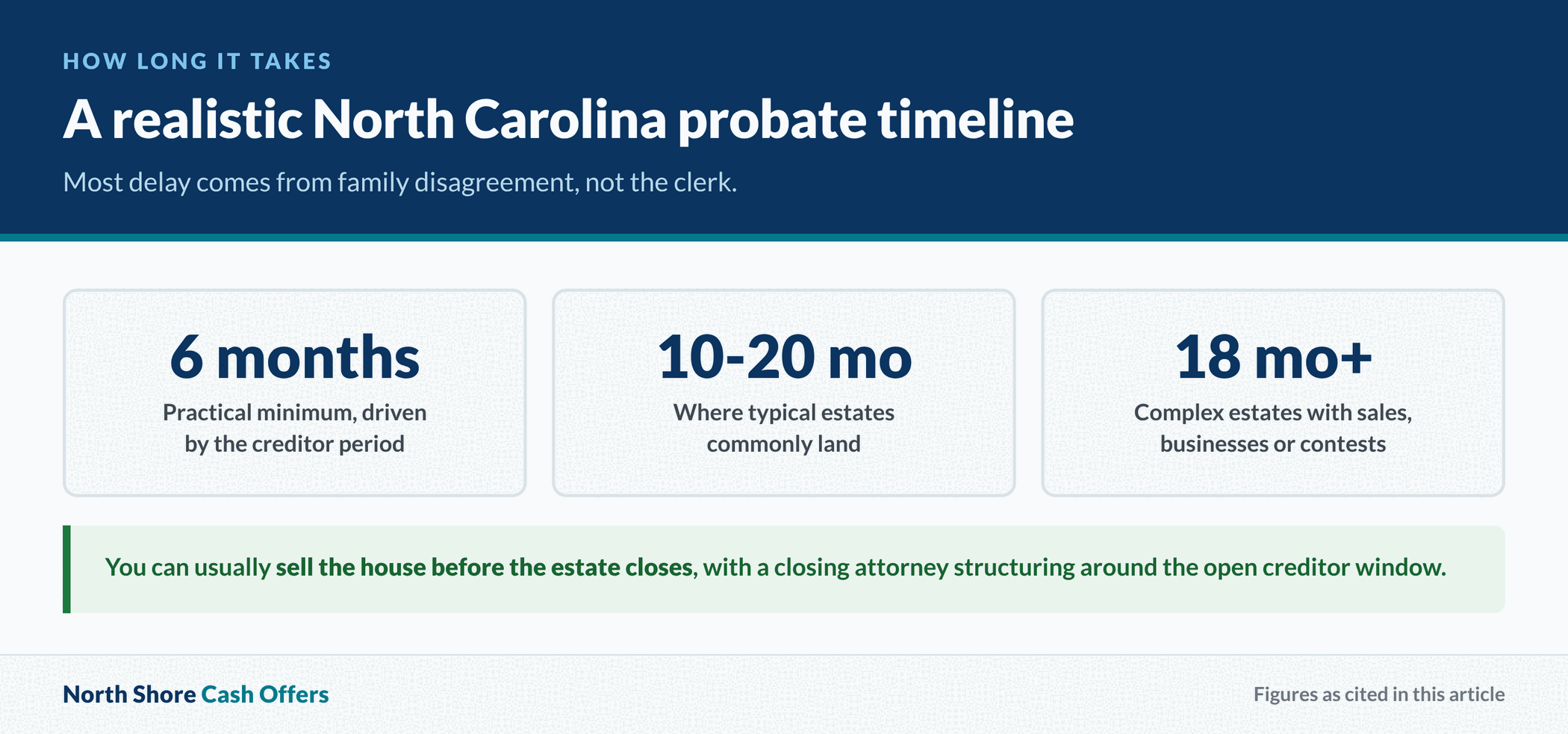
Six weeks is the number families say out loud when a probate estate opens, but then the creditor clock starts and the math falls apart. Creditors generally must present claims by the deadline in the published notice. This deadline must be at least three months after first publication. A creditor who gets mailed notice has at least 90 days from the mailing if that date falls later.
Stack the pieces and you get a realistic floor. The minimum practical length of a North Carolina probate runs roughly six months, driven by the three-month creditor period plus time to file the inventory, pay creditors, and prepare the final accounting. Typical duration commonly lands in the 10 to 20 month range.
What stretches a probate case: contested wills, missing heirs, an estate tax return, a business interest, or a house that won’t sell. Complex estates with real property sales, business interests, contested wills, or federal filings can run 18 months to several years. From what I’ve seen buying houses from estates, most of the delay has nothing to do with the clerk and everything to do with family disagreement.
Can you sell the house before the probate estate closes? Usually yes, and that surprises people. Heirs can convey their interest, or the personal representative can sell under authority from the will or a court petition. A good closing attorney structures around the open creditor window.
An heir in Matthews reached out mid-divorce, splitting assets with a soon-to-be ex, and she was also holding a half interest in her late father’s brick ranch. She didn’t want showings, didn’t want to argue about the pontoon boat still parked in the garage, and told me on a Thursday she just wanted the thing handled. We coordinated with her attorney and the probate file, took the house as it stood, and she never had to set foot in it again.
Frequently Asked Questions
How Does the Probate Process Work in North Carolina From Start to Finish?
You open the estate with the clerk in the decedent’s home county, get letters issued, then publish notice to creditors and file an inventory of everything the probate estate holds. After the creditor window closes and valid debts are paid, you distribute what remains to the heirs or beneficiaries and file a final accounting. The clerk reviews that accounting and closes the probate file.
Does a Small Estate Affidavit Work If the Estate Includes a House?
Not for the house itself. The small estate affidavit only covers personal property under the state’s dollar limit, and real property doesn’t count toward that limit or transfer with the affidavit. Title to the house passes to the heirs at death, but a title company will still want an estate file, or a deed signed by every heir, before it insures a sale. Your closing attorney can tell you which route fits your family.
Can You Handle Probate in North Carolina Without Hiring a Lawyer?
Yes, and plenty of people do when the estate is simple: one house, a couple of accounts, heirs who agree. Clerks can hand you the forms and point out what’s missing, but they can’t give you legal advice about creditor priority or a disputed claim. Once a will is contested, an heir is unreachable, or the estate looks like it can’t cover its debts, hire an attorney and pay for it out of estate funds.
Does a Surviving Spouse Still Have to Open Probate on the House?
If the home was titled jointly with right of survivorship, the surviving spouse takes it outright and no probate administration is needed for that property. When the deed carries only the deceased spouse’s name, some court involvement is typically required before a clean sale can close. Your county clerk’s estates division can confirm which path fits your deed.
Will an Inherited House Sell for Less Because Probate Is Still Open?
Not inherently, though buyers using conventional financing sometimes shy away from a property with an unresolved estate file, and that thins your buyer pool. Pricing it right matters more than the probate status. Cash buyers who regularly work with estates, including North Shore Cash Offers, are generally comfortable closing around an open file as long as the title attorney signs off.
If you’re sitting on an inherited house in North Carolina and you’re not sure whether probate applies, what it’ll cost, or whether selling now makes sense, I’m glad to walk through it with you. Call the clerk’s office too; they’re a good resource. And if you’d rather just talk it out with someone who’s done this a few hundred times, we’re here. No pressure, no obligation, no expectation that you sell us anything.
Inherited Houses Across North Carolina
North Shore Cash Offers buys inherited houses across North Carolina, whether the estate file is still open or already closed. Statewide sales have slowed this year, so an estate house can sit longer than heirs expect. If taxes and insurance keep piling up while the clerk’s process runs, you can sell an inherited North Carolina house as-is and skip the cleanout and repairs.
Talk Through Your Estate Sale With Us
Not sure whether probate applies, or whether the house can sell before the estate closes? You can contact North Shore Cash Offers and we’ll work alongside your closing attorney and the clerk’s timeline. There’s no obligation, and you won’t need to clean out the house first. You can also fill out the short form below.