Ninety-one thousand dollars. One seller still owed that much after her closing attorney wired every dollar of her sale proceeds to the bank, and she walked out of that office in Gastonia owning nothing but the debt. She’d done nothing reckless. She bought at the top, refinanced once to cover a roof, then needed to move for work. An underwater mortgage doesn’t care about your reasons. North Carolina homeowners run into this more often than the cheerful market headlines suggest, and the path out is narrower than many hope but wider than many fear.
What Is an Underwater Mortgage, and Do You Have One?
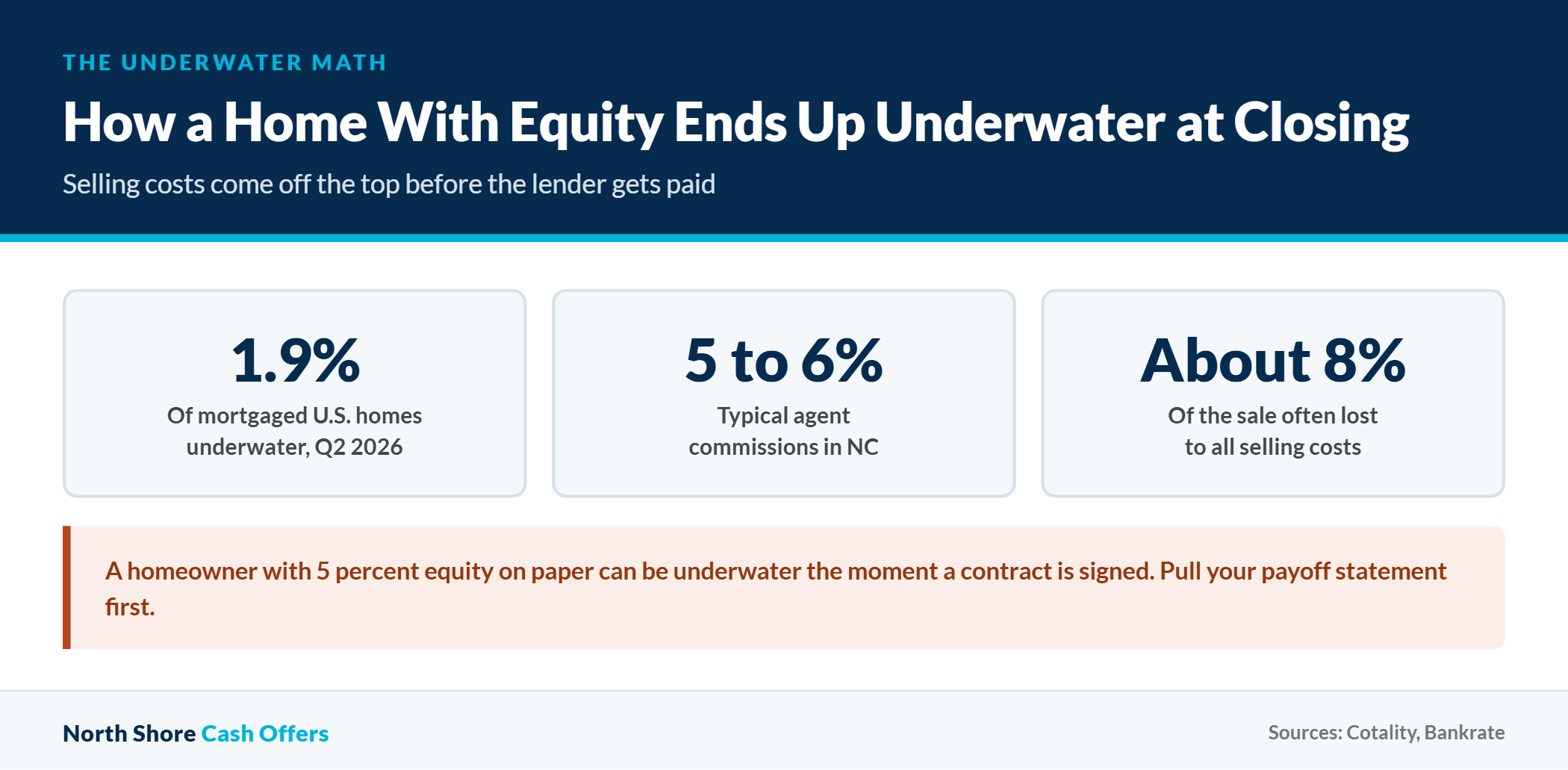
Across the country, roughly 1.9 percent of mortgaged homes, about 1.09 million of them, sat in a negative equity position as of Cotality’s second-quarter 2026 homeowner equity report. Small number. Cold comfort if you’re in it.
An underwater mortgage simply means your total loan balance exceeds what the property would sell for today. Add up your first mortgage, any second lien, a HELOC you drew on, plus unpaid property taxes or contractor liens, and that’s your real debt number.
Now subtract the costs of selling. Agent commissions alone eat 5 to 6 percent of the price in a typical North Carolina listing, according to Bankrate’s breakdown of who pays what at closing. Add attorney fees, excise stamps, repair credits, and you’re often handing over 8 percent of the sale. A homeowner with 5 percent equity on paper has an underwater mortgage the moment a contract gets signed.
Where does North Carolina stand right now? Statewide, homes took a median of 71 days to go off market in October 2026 per the Realtor.com series tracked by the St. Louis Fed. The market is slower than two years ago, and slower markets mean price cuts.
A few years back I looked at a rental in Kannapolis for a longtime landlord who’d owned it since the nineties. His contractor’s estimate for the kitchen came in higher than the kitchen would ever add to the sale price, and the garage was stacked floor to ceiling with tenant leftovers nobody had hauled off. He had equity on paper and none in practice.
Pull your payoff statement before you believe any online estimate. Zillow doesn’t know about your second lien.
Why Would You Sell a House for Less Than You Owe?
Lenders approve short sales for reasons that have nothing to do with missed payments. Hardship, yes, but also documented relocation, divorce decrees, and medical bills on a borrower who’s never been a day late. Plenty of North Carolina sellers assume they have to default first, but that’s wrong, and defaulting first wrecks your credit for no reason.
Job transfers drive a lot of these, with Charlotte’s banking sector and Research Triangle Park employers relocating people, while Fort Bragg and Camp Lejeune move people on orders that don’t negotiate.
Then there’s the math of holding on. If your rental income doesn’t cover principal, interest, taxes, and insurance, every month of waiting adds to the hole. I’ve watched landlords bleed six or eight hundred a month for three years hoping values would catch up, and the arithmetic almost never rescued them.
Divorce creates a particular kind of underwater mortgage problem. Two people, one loan, one house neither can refinance alone. A court can order a sale, but a court can’t make a buyer pay more than the appraisal supports.
People outside North Carolina don’t understand how much storm damage matters here. Western counties around Asheville and Boone are still working through recovery. Properties with unrepaired damage appraise far below their pre-storm value, while the loan balance sits unchanged and the owner ends up with an underwater mortgage.
Would you rather control the sale or let the lender control it? That’s the real question behind most of these decisions. Selling short keeps you at the table, negotiating terms and choosing the closing date, while foreclosure takes all of that away.
What Happens If You Sell Your House for Less Than You Owe in North Carolina?
A couple in Winston-Salem listed in spring, got an offer in six weeks, and found out at the title search that a judgment from an old business debt had attached to their house. Their underwater mortgage was bad enough, but the judgment lien meant two creditors had to agree before anybody signed anything.
The closing attorney runs the numbers first, since North Carolina uses attorneys for residential closings rather than escrow companies, and that attorney orders the payoff from every lienholder. If total payoffs plus costs exceed the sale price, the transaction can’t close without somebody taking less or you bringing cash.
A choice then falls to the lender. They can accept the short payoff and release the lien, or they can refuse and let the property go to foreclosure. Most servicers prefer the short sale. A foreclosure in North Carolina runs through the clerk of superior court, costs them money, and leaves them holding a property they never wanted in the first place.
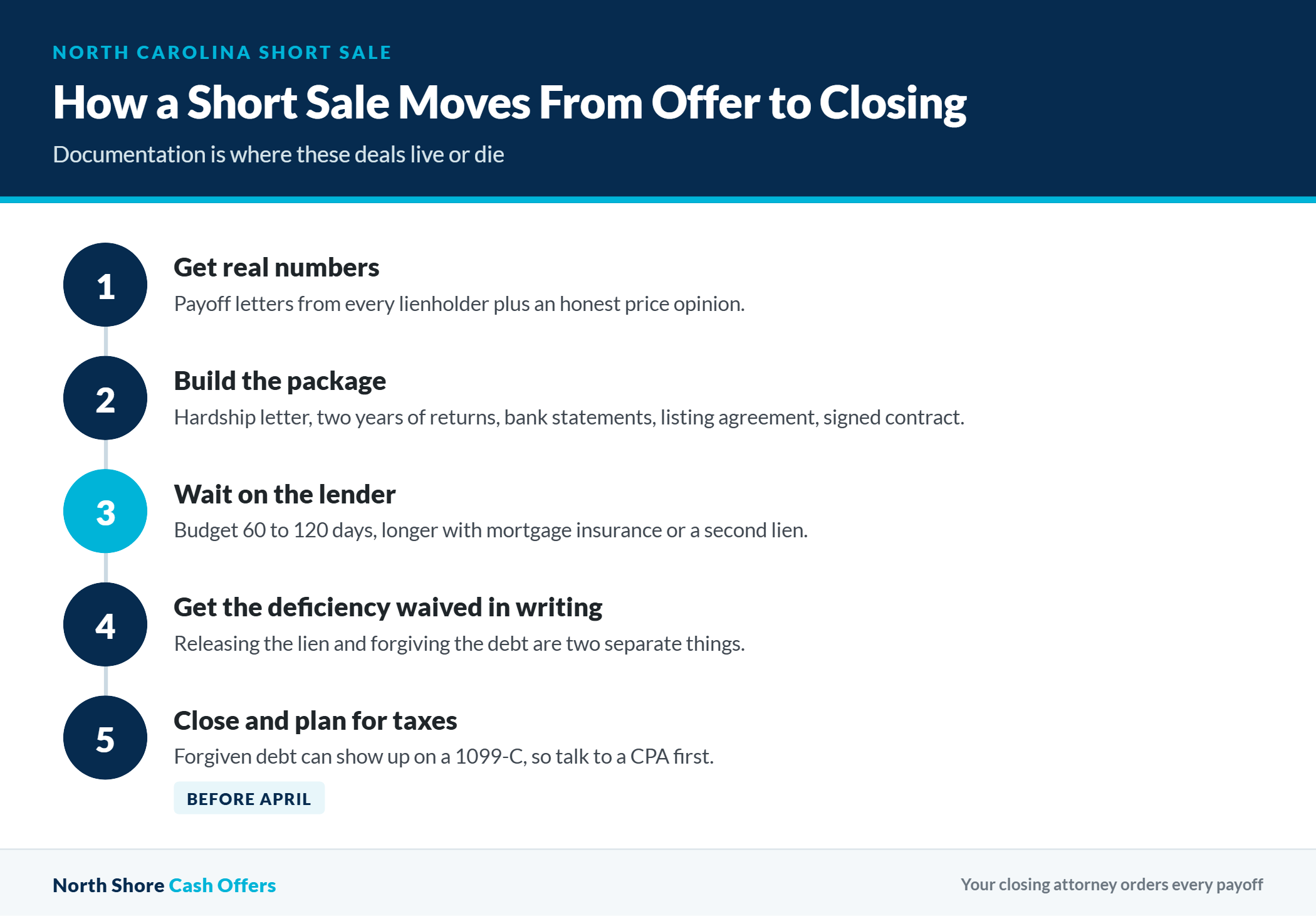
Approval takes time. Budget 60 to 120 days from offer to lender decision, longer if there’s mortgage insurance or a second lien involved. Buyers get impatient, and that’s the single biggest reason short sales fall apart.
One detail that trips up North Carolina sellers: releasing the lien and forgiving the debt are two separate things. A lender can hand over a clean deed and still reserve the right to chase the shortfall. Your approval letter has to say the deficiency is waived, in writing, with no ambiguity. If it doesn’t, keep negotiating.
Can You Pay Off an Underwater Mortgage Out of Pocket Before Selling?
Draining your retirement account to close an underwater mortgage gap is usually the worst option on the table.
That said, the math sometimes works. If you’re short five or ten thousand on a house in Greensboro and you’ve got it in savings, writing that check at closing is cleaner than a short sale. It’s also faster, and leaves your credit untouched. Small gaps deserve cash solutions.
Some lenders will convert the shortfall into an unsecured promissory note instead of demanding a lump sum, so you sign, the lien releases, and you make modest payments on the remainder. Ask about this before you assume you need the full amount liquid.
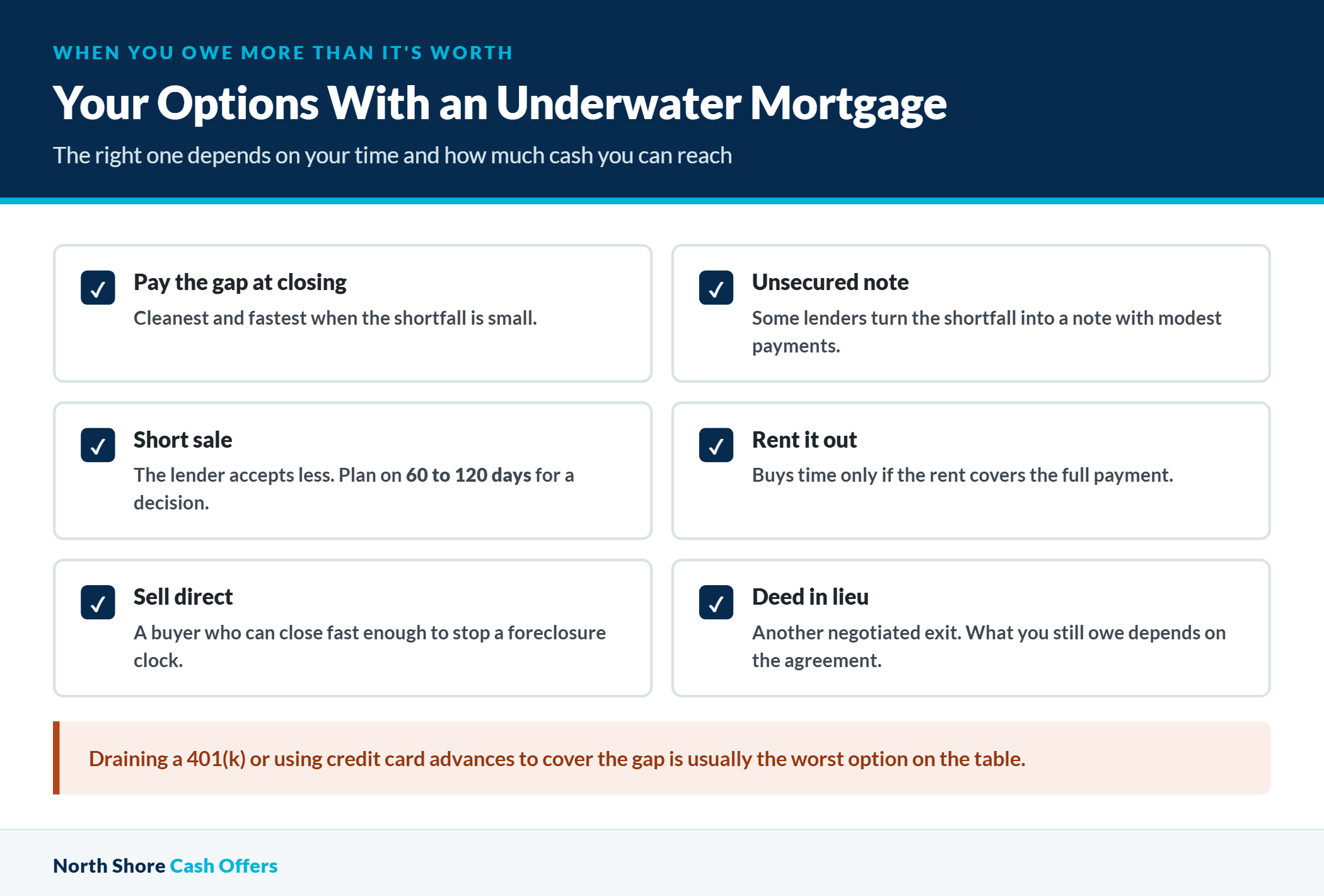
Where I push back hard is on 401(k) loans and early withdrawals. You’re trading protected retirement money for a property that already lost. Credit card advances are worse, since you’re swapping secured debt at mortgage rates for unsecured debt at twenty-plus percent.
Have you actually priced the house, or are you guessing? An underwater mortgage calculation built on a neighbor’s rumored sale price isn’t a plan, so get a broker price opinion or a real appraisal, then subtract real closing costs, then look at the gap.
Renting it out buys time if the numbers cover the note. Durham’s average house price hit $415,000 last month, up 2.5 percent year over year according to Redfin’s October 2026 market data, so holding in certain North Carolina submarkets is a legitimate strategy. Elsewhere the rents don’t support the payment, and holding just extends the loss.
Does a Short Sale Help with an Underwater Mortgage in North Carolina?
“The bank will never approve it.” I hear that constantly, and it’s mostly folklore from 2011 when servicers were drowning in files. Today’s loss mitigation departments have real procedures, real timelines, and staff whose job is approving these.
Credit impact is real but shorter than foreclosure. A short sale shows as a settled account, and most sellers I’ve worked with are financing again within two to four years. A foreclosure judgment follows you considerably longer.
What a short sale does best is cap the damage. You stop the clock on accruing interest, late fees, and attorney costs that get added to an underwater mortgage in default. Every month a North Carolina foreclosure drags on, the balance grows.
Documentation is where these files live or die. Hardship letter, two years of returns, bank statements, a listing agreement, and a signed purchase contract. Servicers reject incomplete packages without reading them.
The honest downside: short sales favor patient buyers. If your situation requires closing in three weeks, a short sale won’t get you there. That’s one reason sellers facing an underwater mortgage sometimes call North Shore Cash Offers instead. A direct buyer who knows the lender approval process can stay in the transaction while the bank takes its time.
Second liens complicate everything. A HELOC holder knows they get nothing in foreclosure, so they often demand a few thousand to release. Negotiating that is normal, and it’s usually worth paying.
Will North Carolina Law Leave You Owing Money After a Short Sale?
Get this part wrong and you close, move on with your life, and get sued for what’s left of the underwater mortgage a year later.
North Carolina has anti-deficiency protections, but they’re narrower than people assume. One statutory protection gives a borrower an offset when the lender itself is the high bidder at a foreclosure sale and buys below true value. Another provision bars deficiency judgments on purchase-money loans where the seller financed the purchase price. Neither one automatically protects you in a short sale.
Why? Because a short sale is a negotiated contract, not a foreclosure. The lender’s ability to pursue a deficiency after a short sale or a deed in lieu depends on what they agreed to. Your leverage is the approval letter, not the statute book.
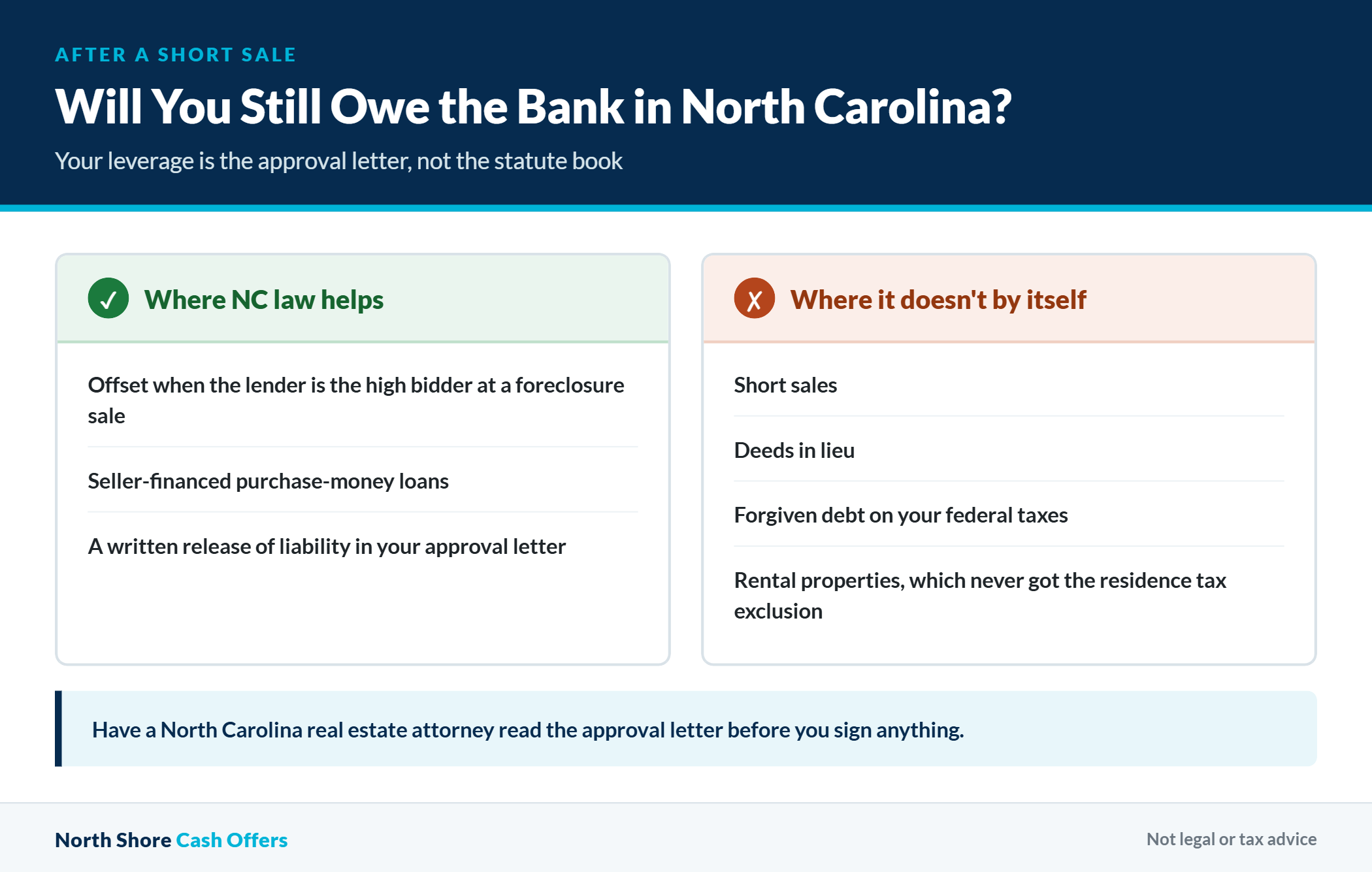
So read it. Look for language releasing you from further liability on the note. If the letter only says the lien will be released, your attorney needs to go back and ask for more. A real estate attorney licensed in North Carolina should review this before you sign; the fee is small next to what’s at stake.
Taxes are the other trap. Forgiven debt is income to the IRS unless an exclusion applies. The qualified principal residence indebtedness exclusion covers debt discharged before January 1, 2026, or discharged under a written arrangement entered into before that date, per IRS Topic 431. Since we’re past that window now, North Carolina sellers forgiving debt today need to look at the insolvency exclusion instead, and that requires a careful look at your total assets and liabilities. You claim exclusions on Form 982, and this is a conversation for a CPA, not a blog.
Rental and investment properties never qualified for the residence exclusion anyway. Different rules, different planning.
What Should You Ask Before Listing a Home with an Underwater Mortgage?
Sitting at someone’s kitchen table, the first thing I ask is what the payoff letter says, not what they think the house is worth.
From there, questions worth asking your agent: how many short sales have you closed in this county, and will you stay on the file for four months without a paycheck? Many won’t. An agent used to clean Wake County listings may not have the patience an underwater mortgage file demands. Wake County’s median sale price was $459,000 over the three months ending October 2026, down 4.1 percent year over year, with homes averaging 50 days on market, according to Redfin. Falling prices in the state’s biggest metro mean more sellers are discovering an underwater mortgage they didn’t have eighteen months ago.
Ask your lender directly whether they’ll consider a short sale and what their package requires. Ask whether they report to credit bureaus as “paid in full” or “settled for less.” Those words matter to future underwriters.
Price it right the first time. Chasing a falling market with weekly reductions is how an underwater mortgage turns into a foreclosure filing. I’d rather list once at a defensible number than three times at wishful ones.
A couple in Mooresville called me on a Tuesday after moving the wife’s father into assisted living. His ranch house had a wheelchair ramp the family had built the previous summer. It had an underwater mortgage, with a balance north of the neighborhood comps. No one had the time or money to prep it for a retail listing. They needed certainty on a date, not a maybe. A direct offer solved it without the father’s care plan getting disrupted.
That kind of certainty is what North Shore Cash Offers brings to underwater mortgage situations where timing matters more than squeezing out the last few thousand.
Frequently Asked Questions
What Happens If I Sell My North Carolina House for Less Than the Loan Balance?
Your closing attorney can’t disburse a deed unless every lienholder gets paid or agrees to release for less. So the sale only happens with lender approval, and that approval comes with conditions about the shortfall. Either you bring the difference, the lender forgives it, or the lender keeps the right to collect it later.
What Can I Do If My Home Is Worth Less Than What I Owe?
You have more routes than you’d think. You can pay the gap at closing, negotiate an unsecured note for the balance, pursue a short sale or rent until values recover. Another option is to sell directly to a buyer who can close fast enough to stop a foreclosure clock. The right answer depends on how much time you have and how much cash you can reach. An underwater mortgage with a six-month runway is a different problem than one with a sale date already set.
Will I Still Owe the Bank After Closing?
Possibly, and it comes down to the wording in your approval letter rather than anything automatic in North Carolina law. The state’s anti-deficiency protections described above apply in specific foreclosure situations, not to every negotiated payoff. Get a written release of liability before you sign, and have an attorney confirm it says what you think it says.
Is Forgiven Mortgage Debt Taxable in North Carolina?
Canceled debt generally counts as income on your federal return, and the lender reports it on a 1099-C. The residence-specific exclusion described earlier had a hard cutoff date, so most sellers today are looking at the insolvency exclusion or nothing. Talk to a CPA before closing, not in April.
Can I Sell If I’m Already Behind on Payments?
Yes, and moving earlier gives you better options than waiting. Once a foreclosure hearing is scheduled with the clerk of superior court, your window narrows and the fees added to your balance keep climbing. Lenders tend to be more flexible on an underwater mortgage when a real contract is already in hand.
If you’re looking at a payoff letter that doesn’t match what your North Carolina house will sell for, we’re glad to walk through the numbers with you. No pressure, no obligation, and no judgment about how you got here.
Why Flat Prices Matter for North Carolina Owners Who Owe Too Much
Canopy MLS counted 4,304 homes sold across the Charlotte region in June 2026, and the median price rose just half a percent to nearly $417,000, according to WFAE’s report. That’s flat. If you’re waiting for appreciation to close the gap on your underwater mortgage, a flat market can stretch that wait out for years.
Your payoff letter and an honest price opinion tell you more than any headline. Start there, then decide whether time is on your side.
Talk Through Your Payoff Numbers With Us
No two underwater mortgage situations look the same. If you’d like help sorting out whether a short sale, a cash payment at closing or a direct sale fits best, contact North Shore Cash Offers and we’ll go over it with you. You can also fill out the short form below to get a no-obligation cash offer on your North Carolina house.