
A pest control operator once told me that the humid Piedmont clay under most of our homes is basically a five-star hotel for subterranean termites. He wasn’t exaggerating. North Carolina sits in a stretch of the Southeast where wood, warmth, and wet soils meet, and that combination means termites aren’t rare here. They’re ordinary. Selling a house with termites in North Carolina is something thousands of homeowners do every year, quietly and without drama, once they understand what the process really asks of them.
How Much Damage Can Termites Really Do to Your House?
For years I assumed termites ate a house from the outside in, like weather. Subterranean termites come up through soil contact, build mud tubes along foundation walls, and work inside the wood where nobody looks.
A sagging floor joist in a 1970s ranch in Burlington usually got that way over several seasons, not overnight. Heavy rains push moisture into the dirt under a house, crawlspace vents get blocked by shrubs, so the wood stays damp enough to invite trouble.
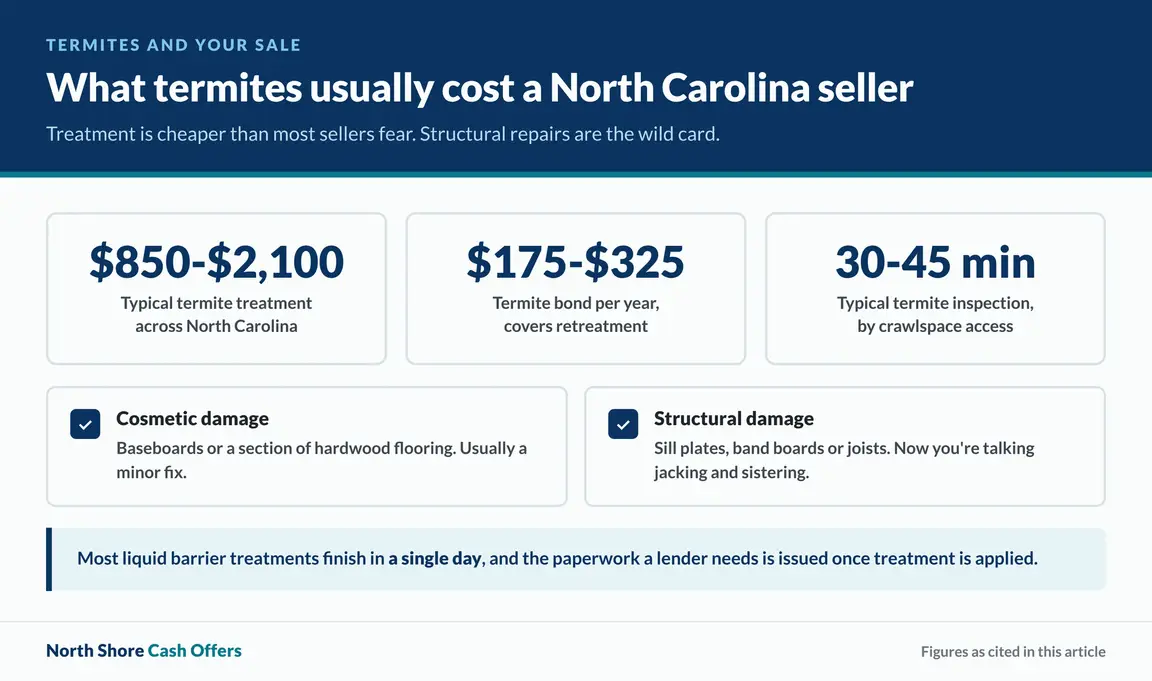
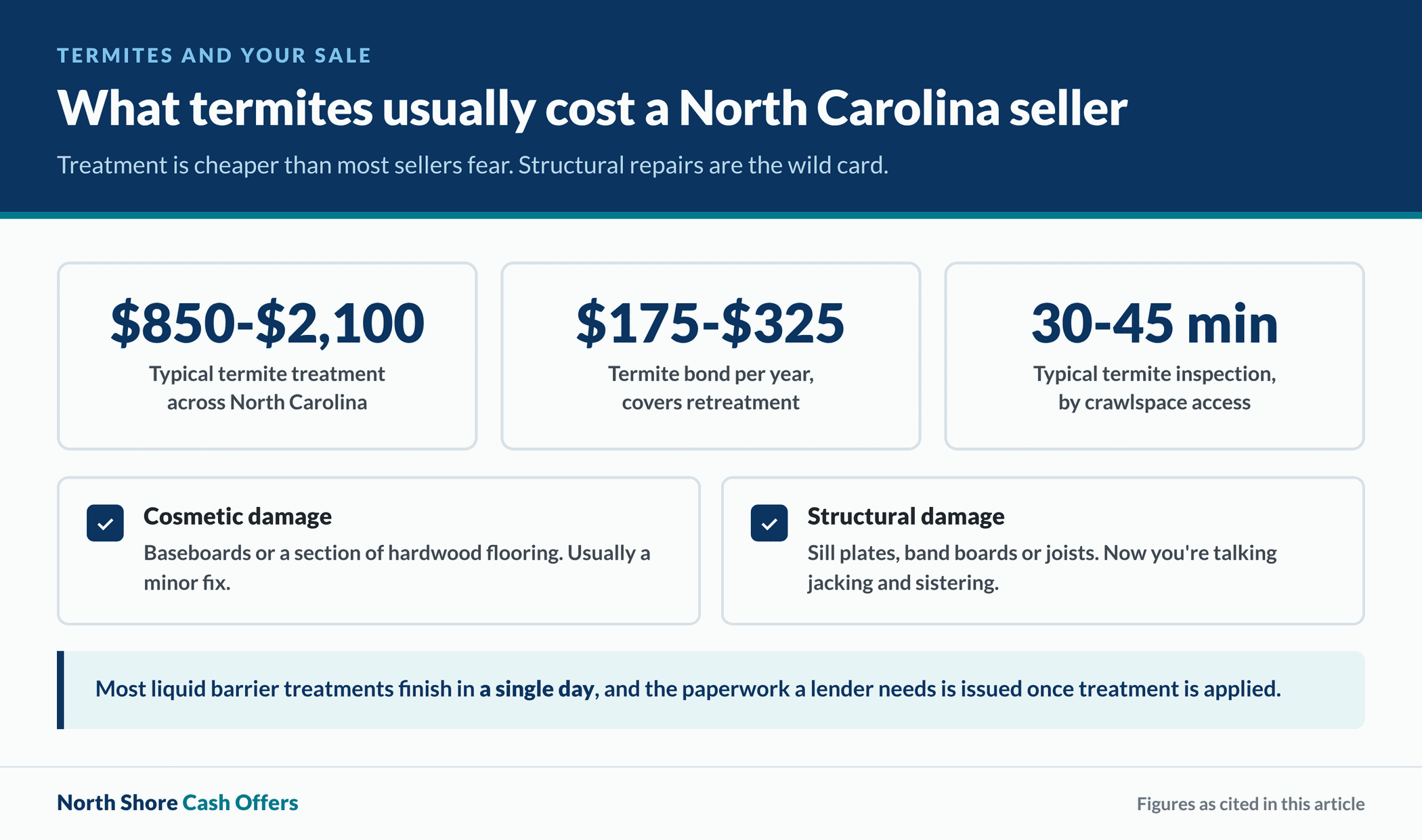
What it costs to fix depends entirely on where the insects got to. Cosmetic damage to a baseboard or a section of hardwood flooring is minor. Damage to sill plates, band boards, or joists is a different conversation, because now you’re talking about jacking and sistering structural members.
Treatment itself is cheaper than most sellers fear. Termite treatment across North Carolina runs roughly $850 to $2,100 depending on the method used, per 2026 pricing data from Pest Control Pricing. Repairs are the wild card, not the chemicals.
One set of siblings I bought from wanted a clean exit, no cleanout, no contractors, and when we pulled back the insulation in the crawlspace we found old termite tubes running up two piers. They’d been living with that for a decade without knowing.
Old evidence isn’t the same as active termites. I keep having to tell sellers that. An inspector can usually tell the difference between dead tubes from a treatment in 2004 and fresh activity feeding right now, and that distinction changes the whole negotiation.
Can You Sell a House with Termites in North Carolina?
Yes, you can sell. North Carolina has no law barring the sale of a house with termites, and houses with active infestations change hands here constantly. What the state does require is honesty. Owners of residential real estate including single-family homes, condominiums, townhouses, and buildings up to four units must give buyers a Residential Property and Owners’ Association Disclosure Statement under the Residential Property Disclosure Act, G.S. 47E. That form lives on the North Carolina Real Estate Commission site.
Timing is the piece sellers get wrong. The disclosure statement has to reach the buyer no later than the time the buyer makes an offer, not later in the process when you’d rather talk about it.
Interesting wrinkle in the form: for most questions a seller may answer “No Representation,” making no claim either way, but what you may never do is answer falsely or hide a defect. Checking “No Representation” about termites is legal, though whether it’s smart depends on your buyer pool, since a cautious buyer reads that box as a yellow flag.
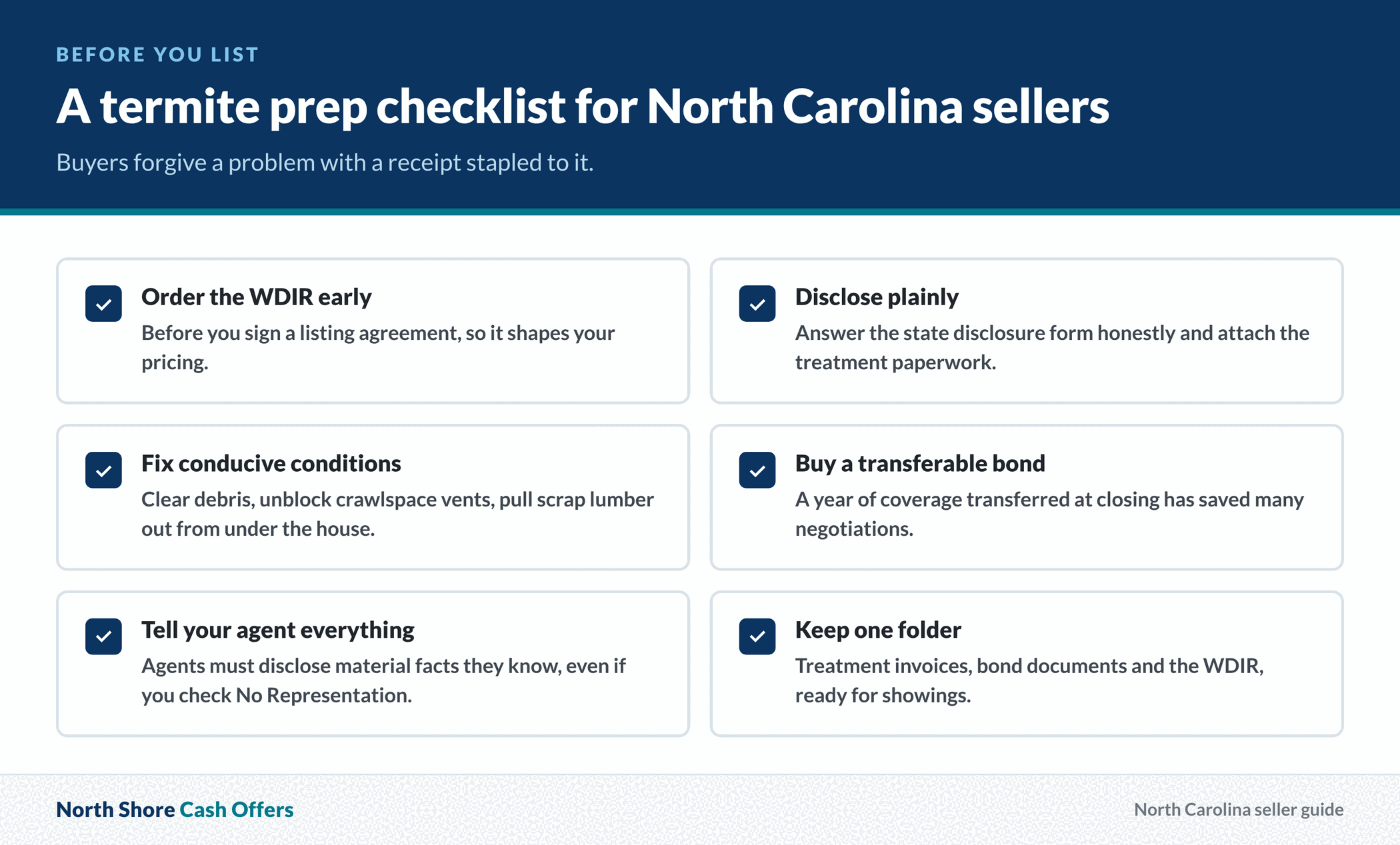
My opinion, which not every agent shares: disclose the termites plainly and attach the treatment paperwork. Buyers forgive a problem with a receipt stapled to it, but they won’t forgive surprises found during their own inspection, and that’s when sales fall apart over a $1,200 issue.
What Is a WDIR and Why Does Your Sale Need One?
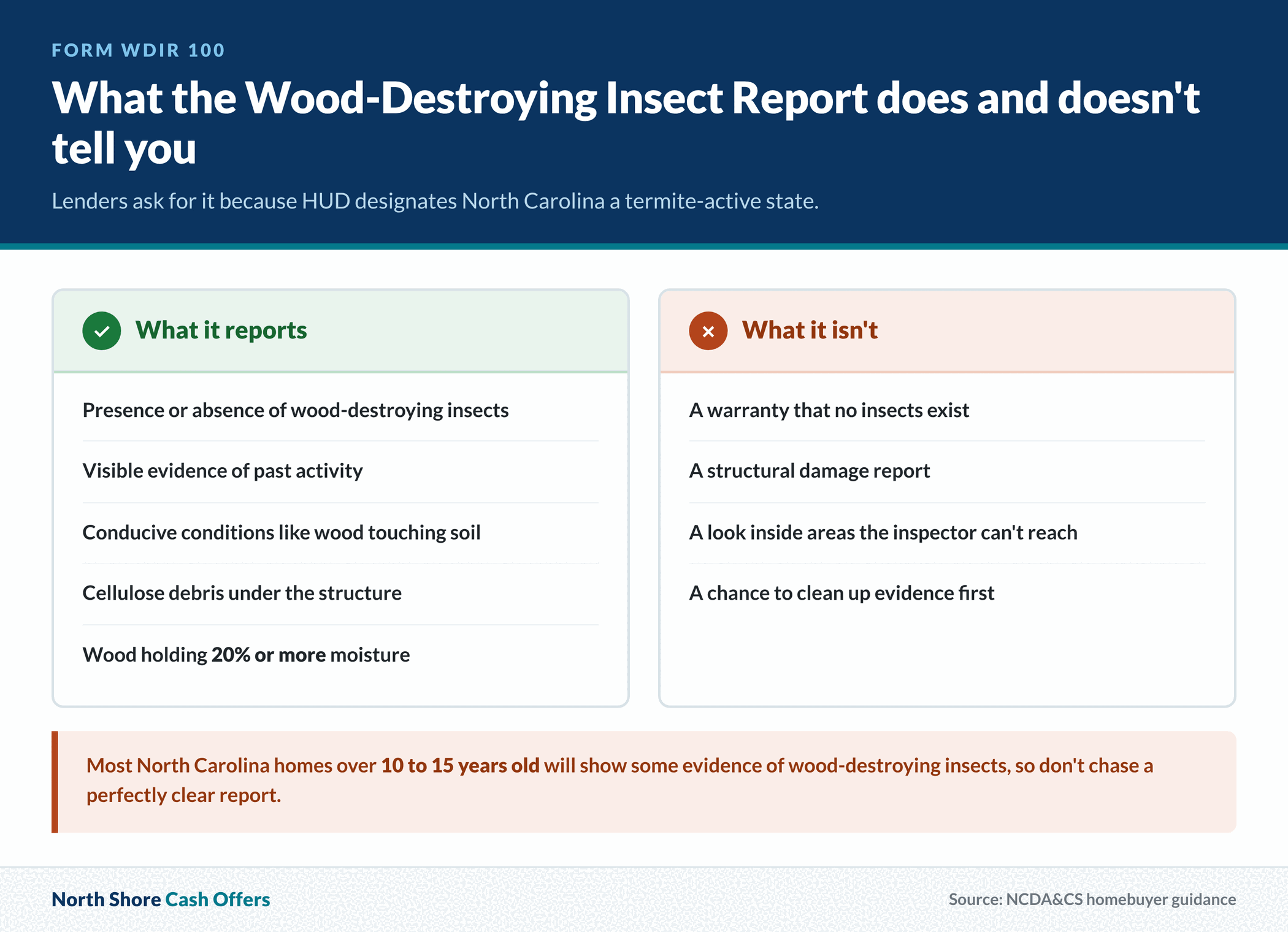
A seller in Raleigh learned at closing that her buyer’s lender wouldn’t fund the loan without a termite inspection on file. North Carolina’s official document for this is the Wood-Destroying Insect Information Report, Form WDIR 100. Adopted by the Structural Pest Control Committee, it reports the presence or absence of wood-destroying insects and their evidence in structures for sale. Lenders ask for it because HUD designates North Carolina a termite-active state.
The WDIR isn’t a warranty that no wood-destroying insects exist; it’s a snapshot of visible presence or absence at the time of inspection. It’s also not a structural damage report, though if insects are in the wood, you should assume some damage exists.
Refreshingly blunt, the state’s own guidance addresses older housing stock. Most North Carolina homes over 10 to 15 years old will show some evidence of wood-destroying insects and may well have been damaged, and lenders and buyers shouldn’t be chasing a “clear” report. You can read the full guidance on the NCDA&CS homebuyer’s guide page.
Beyond termites, the inspector flags conducive conditions. Wood touching soil, cellulose debris under the structure, and wood holding 20% or more moisture all get noted. Fix those cheaply before listing: clear the debris, trim back whatever’s blocking crawlspace vents, pull the scrap lumber out from under the house.
The report should be ordered early in the transaction and read carefully by everyone involved, including the conditions printed on the back.
What Happens When Termites Come Up During Negotiations?
Will the buyer walk away, or just ask for a discount? It usually comes down to a repair request. The buyer can ask for treatment, negotiate the price down, or exit under the inspection contingency, and which of those three you get depends on how prepared you are when the report lands.
If you order the WDIR before listing and hand buyers a treated property with a transferable bond, termites become a footnote. If the buyer’s inspector finds them in week three, you’re negotiating from behind while the clock runs.
What’s happening in the broader market shapes this too. Statewide, homes in the typical North Carolina ZIP code sat a median of 70 days on market as of September 2026. The median list price was $371,000, according to Realtor.com data compiled by Home Value Pros. Slower markets hand buyers more room to push on repairs.
How fast a house moves depends a lot on where it sits. In Lincoln County, covering Lincolnton, Denver, and Iron Station, the average sale price was $466,337 and homes sold in a median of 35 days as of October 2026. A buyer in a faster submarket thinks twice before blowing up a contract over treatable termites.
A termite bond in North Carolina generally runs $175 to $325 annually. It covers retreatment if termites come back to the protected structure. A small yearly cost does a lot of heavy lifting. Buying a year of that coverage and transferring it at closing has salvaged more negotiations for my sellers than any price concession.
Who Fixes Termite Damage Before Closing in North Carolina?
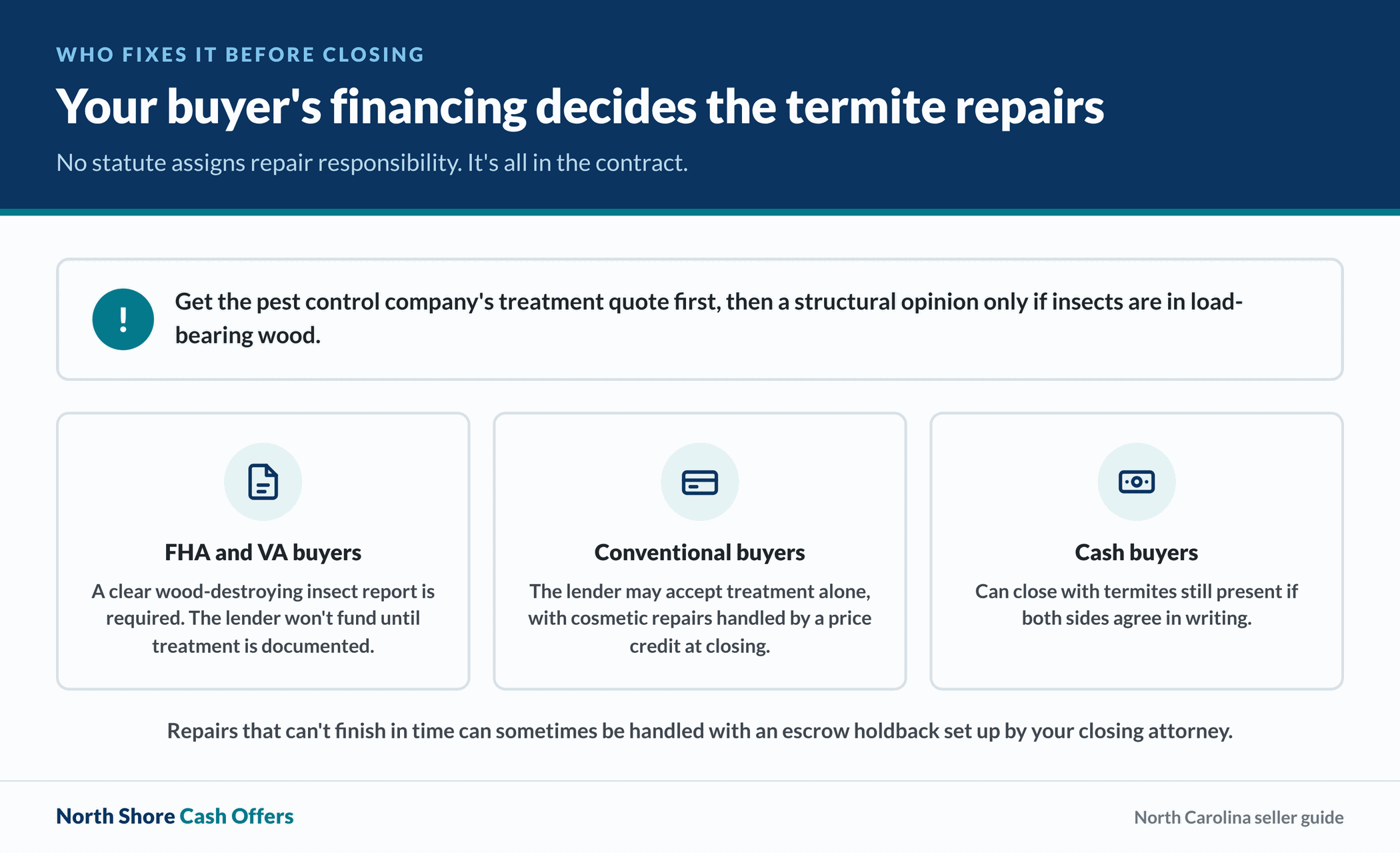
There’s no statute assigning repair responsibility. It’s all contractual, written into your Offer to Purchase and whatever gets negotiated after inspections.
In the Southeast, sellers commonly provide the WDIR, while buyers more often pay for it in other parts of the country. Custom isn’t law, and I’ve seen plenty of North Carolina contracts where the buyer covered it without complaint.
Financing drives the rest. FHA-insured and VA-guaranteed loans require a clear wood-destroying insect report in termite-active states, so with those buyers the repairs aren’t optional. The lender won’t fund until treatment is documented and active termites are gone.
Conventional buyers have more flexibility. A conventional lender may accept treatment alone, with cosmetic repairs handled by a price credit at closing.
Get the pest control company’s treatment quote first. Then get a structural opinion only if the WDIR shows insects in load-bearing wood.
One pattern I keep seeing across North Carolina closings involves escrow holdbacks. When repairs can’t finish before the closing date, the parties sometimes agree to hold funds back and complete the work after. Your closing attorney sets that up, and it keeps a sale alive when a contractor can’t get to the crawlspace in time.
Nobody’s watching the house, moisture builds up, and termites spread through joists while an estate works through probate. If you’re an heir sitting on a property three counties away, the fastest fix is often not fixing it.
Should You Sell Your House As-is with Termite Damage?
A detail that rarely makes it into articles like this one: the WDIR inspector isn’t allowed to destroy evidence. Rule .0602(d) bars a pest control operator from removing or destroying any evidence of wood-destroying insects. You cannot clean up the mud tubes and get a friendlier report, and the enforcement policy treats an inaccurate report as grounds for discipline.
Selling as-is means the buyer takes the termites and the damage at a negotiated price. You still disclose. You just don’t repair. Investors and cash buyers price the work into their offer and close anyway.
Add treatment, structural repairs, carrying costs for the months you’d spend on market, and agent commissions, then compare that total against the discount a direct buyer offers. For heavily damaged properties, as-is frequently wins; for a house needing one treatment and a new section of subfloor, listing usually nets more.
Selling as-is on the open market has a catch worth naming. Your buyer pool shrinks to cash and conventional, because FHA and VA won’t fund an untreated termite problem.
If you’d rather skip inspection negotiations altogether, a local as-is buyer like North Shore Cash Offers will look at the property with termite damage already factored in. No lender clearance, no repair escrow, no second inspection.
A seller with eight months behaves nothing like a seller with eight weeks, which is why that question settles the as-is decision faster than any spreadsheet.
Are There Myths About Selling a House with Termite Damage?
In Matthews, a seller pulled her listing after a pest report showed termites, convinced the house was ruined.
Myth one: insurance covers it. Standard homeowners policies in North Carolina exclude termite damage as a maintenance issue, so don’t build your plan around a claim.
The second myth claims termites only bother old houses. New construction gets hit too, especially where builders left form boards or scrap lumber buried near the foundation. Soil treatment during construction fades over time.
Brick homes supposedly can’t get termites. Brick is veneer over a wood frame in nearly every North Carolina subdivision, and termites tunnel right behind it.
There’s also a belief that a house with termites can’t appraise. Appraisers note condition; the loan program sets the requirement. An appraisal doesn’t fail because of insects, though a lender may condition funding on treatment.
The costliest myth is that you should hide it. Buyers in North Carolina get their own inspection, and discovery mid-contract costs you credibility plus whatever concession they demand. Disclosure up front protects you and keeps the sale boring, which is exactly what you want a closing to be.
Last one: that treatment takes months. A typical termite inspection runs 30 to 45 minutes depending on crawlspace access and the structure’s size, and most liquid barrier treatments finish in a single day. Bait systems take longer to knock out a colony, but the paperwork a lender needs gets issued once the treatment is applied.
What Do North Carolina Realtors® Want You to Know About Termites?
A hundred dollars. That’s roughly what agents in the Triad budget for a termite letter on top of a base home inspection. Greensboro inspections run $425 to $525 for a typical 2,000 square foot home in 2026, plus about $150 for radon, according to Homes in Triad NC. Next to the median sale price in this state, that’s a rounding error for information that protects your whole transaction.
I agree, and I’d go further: order it before you sign a listing agreement. Knowing what’s under your house changes your pricing strategy.
REALTORS® also want sellers to understand how the disclosure form interacts with agent duty. NCREC holds agents responsible for disclosing material facts they know or reasonably should know. So your listing agent can’t stay quiet about termites even if you check “No Representation.” Telling your agent everything, then deciding together how to present it, works better than managing information.
Keep treatment invoices, bond documents, and the WDIR in one folder for showings.
A man called me on a Wednesday afternoon from Fuquay-Varina with a job transfer and five weeks to be out of his house. His garage still had a workbench and a kayak hanging from the rafters, and a pest company had just flagged active termites in the crawlspace along the rear foundation wall. We closed before his start date, termites and kayak included, and he didn’t have to coordinate a single repair from four states away.
That’s the scenario where North Shore Cash Offers tends to be the right call: real deadline, real termite findings, no appetite for a repair negotiation.
Frequently Asked Questions
Is It Okay to Buy a House That Has Termites?
For plenty of buyers, yes. Given how common wood-destroying insects are in older housing stock across this state, walking away from every property with evidence would eliminate a large share of the market. What matters is whether the activity is current, whether structural wood is involved, and whether treatment plus a transferable bond is in place at closing. Buy the inspection, read the inaccessible-areas section, and price the repairs honestly.
How Much Does a Termite Inspection Cost in North Carolina?
Expect a modest number. A standalone wood-destroying insect inspection in most of the state falls in the low-to-mid hundreds, and bundling it with a general home inspection typically shaves the price. Eastern North Carolina providers often quote a flat rate for the WDIR, and Triangle-area pest companies price it similarly. Call two or three licensed operators in your county; the quotes come back fast and the spread is usually small.
Do I Have to Treat for Termites Before I Can Close?
That depends on your buyer’s financing, not on state law. Government-backed loans require clearance, so treatment has to happen before funding. Conventional and cash buyers can close with termites still present if both sides agree in writing. Your closing attorney will confirm what the lender’s conditions actually say.
Will Termites Lower My Home’s Appraised Value?
Not by themselves, in most cases. An appraiser records condition and may call for a repair inspection when damage is visible, but the bigger effect comes from the lender’s requirements and from buyer negotiation. A property with documented treatment and intact framing usually appraises in line with comparable homes nearby.
Can I Just Check “No Representation” and Move On?
Legally, that box exists and sellers use it. Practically, a buyer reading “No Representation” next to a question about wood-destroying insects assumes the worst and inspects harder. I’d rather you disclose what you know, show the treatment record, and let the buyer relax than invite suspicion over a line on a form.
What If the Damage Is Worse Than the Report Suggests?
The WDIR only covers what the inspector could see, which is why the inaccessible-areas section exists. If you suspect hidden problems behind finished walls or under a sealed crawlspace, bring in a licensed contractor for a structural opinion before you price the house. Guessing high scares buyers; guessing low blows up contracts at the eleventh hour.
Does Selling As-is Mean I Can Skip Disclosure?
No. As-is describes who pays for repairs, not what you’re required to tell a buyer. The Residential Property Disclosure Act applies whether you’re listing with an agent, selling by owner, or selling to an investor. Honest paperwork and an as-is sale fit together perfectly well.
If you’re sitting on a house with termites in North Carolina and you’re not sure whether to treat it, list it, or sell it as-is, we’re glad to talk it through. No pressure, no obligation, and no judgment about the condition of your crawlspace. Call when you’re ready, or don’t call at all and just use what’s here to make a better decision on your own.
Selling a Termite House Anywhere in North Carolina
North Shore Cash Offers buys houses across North Carolina, and termite damage doesn’t change that. NC REALTORS reported a statewide median sales price of $375,000 in August 2026, with 5.81 months of inventory. That’s a balanced market, so buyers have time to push hard on every inspection finding. If you’d rather skip that back and forth, you can sell your North Carolina house as-is and leave the termite repairs to us.
Talk With Us About Your House and Its Termite Report
Maybe termites showed up on an inspection, or maybe you only suspect them. Either way, you can contact North Shore Cash Offers and we’ll come see the house as it stands. You won’t need to treat or repair anything first, and there’s no obligation. You can also fill out the short form below whenever you’re ready.